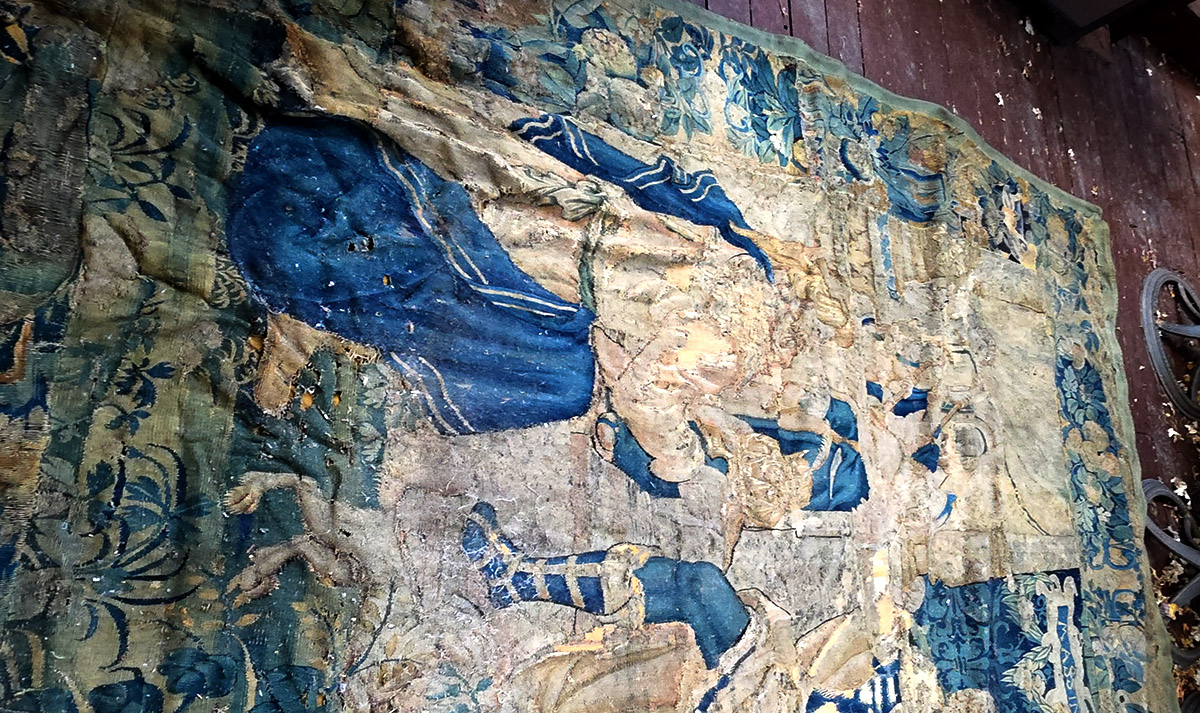
 This tapestry serves as a mirror of contemporary 17th-century Renaissance diplomacy, and the often tragic misuse of power. 21st-century people find it difficult to understand a world, in the deep past, without writing or much reading. The people of Renaissance Europe saw visual symbols. More learned folks recognized a narrative played out in visual figures and symbols. People conceived of their world in story from through metaphors. These pictorial narratives often played out well-known allegories.
A Renaissance Connection to Church
A fabulous case in point is this mid-17th-century Flemish tapestry, approximately fourteen by eleven feet. The clue to the narrative lies in the phrase at the top of the tapestry: Iesus Nazarenus Rex Iudaeorum, “INRI” in shorthand. This tapestry’s vision shows a nobleman on a throne, his scribe, high priests, and courtiers, all in Renaissance-period attire.
It depicts the moment before Pontius Pilate “washes his hands” in the Bible. The moment when he dictates the death sentence of Jesus to his scribe, so the top of the cross reads “INRI,” the charge against Christ. Visual pictures like this tapestry of biblical themes in European courtly Renaissance styling connected the Renaissance nobleman, or high-ranking king/church official, with Christ’s era.
Viewers with knowledge of the Gospels immediately made this prohibitive connection when they viewed this narrative tapestry in a Great Hall or church. The nobleman in this tapestry shadows Pontius Pilate. The tapestry shows us a beautifully dressed Renaissance man on a high throne, surrounded by a cornucopia of fruit and flowers, symbols of wealth. Positioned underneath the throne we see a scribe with a scroll. At the top of the tapestry reveals the result of the scribe’s work: a phrase emphasizing “Rex” set above the action Iesus Nazarenus Rex Iudaeorum.
No Reading Needed to Teach Lesson in the Imagery
In the scene of the 17th century tapestry we see courtiers and scholarly men with beards. They’re presumably those high-priest figures who asked Pilate in the Gospel of John to alter the text of the charge nailed to the Cross. The allegory: the scribes and the Pharisees fight a battle with no winner. Abuse of power leaves only the losers to suffer.
My client asked what this tapestry, in its current condition, is worth. Furthermore she asks whether restoration of the tapestry costs more than the market value in its present condition. She also asks about the rarity of the tapestry.
Late Renaissance Flemish tapestries often pictured the narrative of Christ before Pilate in many visual scenarios. Many of them lost their color vibrancy. Some suffered such drastic fiber loss that we see bare spots where the silk and wool decayed, exposing the white backing strings of the tapestry.
Worth Restoration?
An allegorical biblical tapestry with no identifiable maker’s mark and no certainty of origin, in this distressed condition, will bring $6,000–$8,000 to the right buyer. The market will apply a discount of close to fifty percent compared with what a tapestry in better condition might receive. It may need two levels of restoration may be needed. The National Museum of Sweden offers a fabulous explanation of this on YouTube.
If the wool and silk needs infilling, a master weaver will charge upwards of $7,000 to start work. The weaver will determine if a supportive backing will relieve the tapestry’s stress, which may cost around $2,500. If the iron-mordant dye has eaten the wool thin, then this kind of reweaving runs hugely expensive, and worth it if the piece is museum quality and RARE. Thus restoration outpaces market value, but also consider historical value. If we don’t restore the tapestry at the very least, these works dwindle away in quality and condition.
Fine master re-weavers include Twill Conservation and Rug Ideas LA. Find any conservator worth their salt listed as certified at the American Institute for Conservation.
Weigh the market value if sold today, versus the value when restored, usually not that great a difference. My recommendation is to offer this as a donation and make a non-cash charitable contribution, and deduct the Fair Market Value..