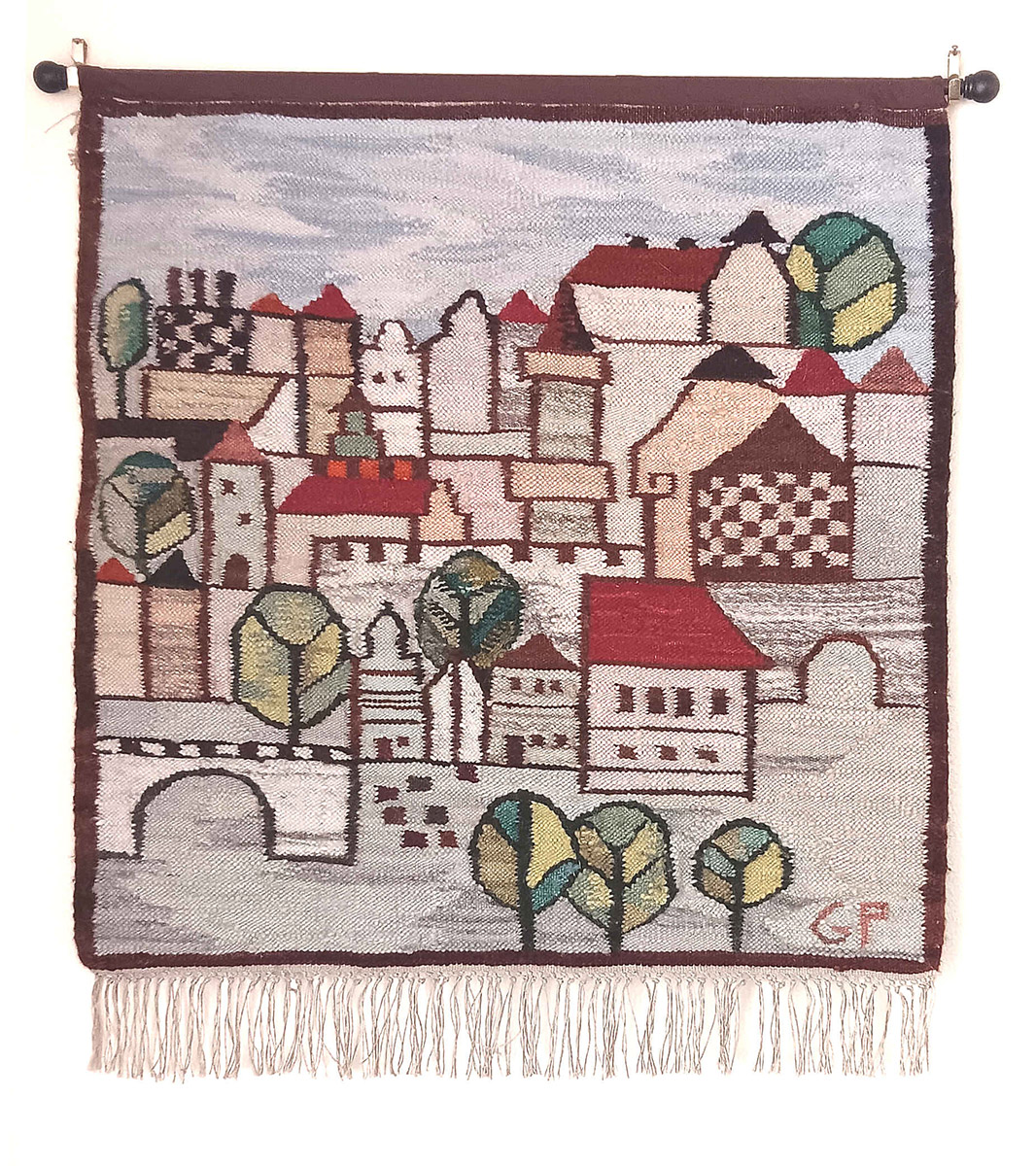
 B’s daughter inherited a wall-size Polish tapestry from her non-Polish grandparents. B wonders how this piece came into their hands. I’ll tell you, B! Your daughter’s grandparents were liberal, enlightened lovers of folk culture, and probably liked Woody Guthrie, too!
This tapestry serves as a prime example of the mid-20th-century interest in folk art of all kinds. I particularly associate this movement with the 1970s. Likewise the classically trained artist Piotr Grabowski (born 1933) created this tapestry in the 1970s. I see his name on the label on the back of the work. He graduated with honors from the Academy of Fine Arts in Kraków in 1957. That same year he became a member of the Association of Polish Artists and Designers, a formidable group with a philosophy somewhat unusual for its time. They edified craft art as fine art, and fine art also a craft.
An Important Distinction
In the United States during the mid-20th century, some enlightened, liberal-minded individuals shared precisely this philosophy. Consider the fine Danish Modern furniture of the 1960s, crafted in teak, rosewood, and walnut. Furniture, by definition, utilitarian, some increasingly considered it art. Knowledgeable buyers sought out pieces made by particular artists and designers, Finn Juhl serves as an excellent example.
The 1970s emerged as an era in which traditional craftsmanship began to receive serious recognition. This became true among many of the same collectors who purchased folk music records, including those by The Weavers. Many of the same people who purchased traditional Polish tapestries in the 1970s also appreciated ethnic folk dancing. They considered utilitarian or decorative object made from wool or wood art.
Snobbism Frowned On
This was a relatively novel concept, and European importers recognized that some liberal, educated, upper-middle-class Americans paid for folk music, hand-loomed tapestries, and objects with distinctly regional, peasant-style themes. B’s daughter’s tapestry is a wonderful example: it depicts a quaint Polish village.
At this time, those of us who afforded Prairie dresses, an American folk-inspired style, bought them from designers such as Jessica McClintock. In England, they bought the same sort of folksy dresses from Laura Ashley.
Educated artists such as the creator of B’s daughter’s tapestry moved easily between painting and textile design, bringing the sensibilities of a formally trained painter to traditional, handcrafted textiles. I myself own a Polish tapestry, although mine depicts a Polish mountain range rather than a quaint village. Even though these works have an intentionally somewhat amateurish quality, they’re often designed by exceptionally accomplished artists. That seemingly amateur quality was, in fact, considered part of their charm.
Piotr Grabowski subsequently became the artistic director of the Opole Cooperative and served as its president from 1991 to 2002.
On 1stDibs, you’ll find mid-century modern and folk-art dealers offering tapestries by Grabowski, including examples made for export and imported into the United States by a New York firm, Cepelia, for thousands of dollars in today’s market. Cepelia was the commercial and organizational network through which Polish artist-designed art and crafts reached international markets. Its New York showroom became a gathering place for the liberal-minded lovers of folk art during the 1960s and 1970s. They even held openings accompanied by folk music!
Grabowski Respected Designer
Although the actual weaving was likely executed by skilled weavers in the Opole village cooperative. The title of Grabowski’s tapestry is indeed Grzebyk – Opole Houses. Grzebyk refers to a particular style of kilim weaving native to Poland. Opole is a region in southwestern Poland with a strong tradition of folk culture and artistic production.
In the late 1960s, magazines such as Interiors praised Cepelia tapestries and documented the growing American appreciation for translating regional visual culture into contemporary artistic textiles. A case in point is the period’s enthusiasm for macramé!
The New York showroom, located at the rather fashionable address of 5 East 57th Street, is an important part of this story. The fact that this seemingly amateurish, traditional tapestry depicting a southwestern Polish village entered that showroom places it within the broader postwar American appreciation of European craftsmanship, including furniture design, textile design, and artist-created decorative arts.
I’m sorry I mentioned macramé. I DID weave such a massive terra-cotta flower-pot holder myself back in the 1980s!