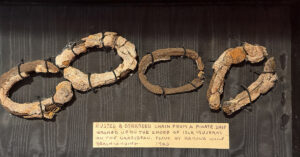
 A remnant called “Ramona’s Chain” presents a fantastic range of possible histories. The card beneath four links states: “Rusted and Corroded Chain from a Pirate Ship Washed up on the Shore of Isla Mujeres in the Caribbean: found by Ramona while beachcombing in 1963.”
Did these components come from a pirate ship? The Golden Age of Piracy, primarily meant to undermine Spanish or English authority in the West Indies, happened 1650–1680, until the 1820s. The Caribbean became the hotbed of privateering from 1628-1638, with the peak at five hundred ships raided.
Why privateering in the 17th century?
First, the illegal but lucrative slave trade battled on the seas. Second, major seafaring nations, Spain, England, and the Dutch, vied for colonial power in the Caribbean. Third, monarchs underhandedly encouraged pirates who undermined competing nations. English Charles II knighted Henry Morgan, for example, because he sank Spanish ships, dying a peaceful death as Governor of Jamaica.
If this chain originated on a pirate ship of the Caribbean, we assume it came from the mid-17th to 18th centuries. If captained by a 17th-century pirate, likely that ship was a frigate, the premier fast ship of war.
What heft of iron chains did a frigate carry in the 17th century?
17th-century frigates carried iron anchors connected to massive hemp rope cables. Chains weren’t standard in the mid to late 17th century. Looking at the heft of the chain found by Ramona in 1963, could this chain bear the weight of an anchor? Typical anchors on a 17th-century frigate ranged from a hundred-fifty to eight-hundred pounds. However, a “chain stopper” secured the anchor to the ship. Or Ramona’s chain may’ve been an element of the chain pump common on 17th-18th century frigates. Chain, wheels, and plates turned manually to remove water from the bilge, discharging through the scuppers.
Ramona’s links aren’t strong enough for a heavy anchor, hoisted from the sea floor. Unless Ramona’s chain entered the sea later than the 17th or 18th century. Only a modern high grade alloy chain survives four-hundred years. Chains made from standard steel likely came with a shorter lifespan.
In the 17th and 18th centuries chains created “boom defenses.” A huge chain stretched across a body of water to deter enemy ships’ passages. These chains appeared massive, some six hundred yards long, composed of iron links two feet in length. Each link weighing a hundred-forty to a hundred-sixty pounds each.
Ramona’s links might come from a lighter heft hand-forged 17th-or 18th century chain.
Which frigate? Which commander?
Two pirates plied the waters around Isla Mujeres in the late 17th and early 18th centuries. Henry Morgan (1635, Wales – 1688, Jamaica), the most famous of the plunderers of Spain’s Caribbean colonies, seized Jamaica from Spain in 1655. He gained Dutch colonies for England. In 1668 he captured Cuba. He raided Venezuela and captured Panama as the captain of thirty-six pirate ships.
Another pirate active in the area in the late 18th early 19th century built a home on Isla Mujeres. Fermín Antonio Mundaca y Marecheaga, a slave trader to Cuba and a privateer of foreign ships, built a sixteen hectare plantation and gardens of stone, “Vista Alegre” in 1854. The farm encompassed forty percent of the island. When he fell in love he dedicated the land to his paramour, dark eyed Martiniana Gómez Pantoja (b. 1862), thirty-seven years his junior. The stone gates of his estate proclaimed, “La Entrada de la Trigueña,” the brunette never entered. She married a young local, and Fermín lost his mind. He carved a stone mausoleum in the island’s cemetery, with one façade showing a skull and crossbones, the other a likeness of La Trigueña. His epitaph to her: “As you are, I was, and as I am, you will be.” However, his remains aren’t inside!
This empty tomb is a fitting end to a saga of the feminine spirit presence on the island so aptly named in 1517 by Spanish explorer Francisco Hernández de Córdoba, “Isla Mujeres.” Captain witnessed Mayan female statues, dedicated to Ixchel, the goddess of the moon, fertility, and medicine. Devotees made the pilgrimage to the temple and lighthouse on the southern tip of the island.
The aggressive, masculine world of buccaneers, pirates, frigates, conquest and plunder, all sunk. What remains is the Island of Women, and a rusted chain.