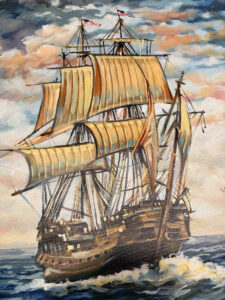
 DF, a former servicemember, a U.S. Marine, sent this 20th century painting and brought a tear to my eye. This painting shows a tall ship by an amateur, signed in Arabic, rendered in a talented copyist style. It depicting the USS Philadelphia, a warship originally built between 1788 and 1799. They commissioned the 1,240-ton, 36-gun frigate in April 1800 under the command of Stephen Decatur Sr.
This painting serves as a fine example of the power of a work of art to fuse the past, present, and future into one image. DF, a Marine, knows the history that occurred on the “Shores of Tripoli.” That battle for this ship and its crew marked the first time the American flag raised over foreign soil. The first victory by the U.S. executed by the fledgling Marine Corps. America waged the first foreign engagement against the Ottoman Empire’s state-sponsored piracy, a war over the free flow of commerce, with bad actors capturing money, men, and ships on the seas between Gibraltar and Turkey.
Why This Ship Became A Symbol Of Endurance
In 1801 the Ottoman Empire’s ruler, Pasha Yusuf Karamanli, demanded a large tribute from the third U.S. president, Thomas Jefferson. In exchange he promised to protect commerce and prevent enslavement of sailors trading along the Barbary Coast, primarily in northern Libya. Jefferson refused and sent the USS Philadelphia. This action began of the First Barbary War (1801–1805). Much tragedy ensued, but it resulted in the Regency of Tripoli, under the Ottoman Empire, defeated by the U.S. Navy. This remarkably happened only 25 years after the U.S. declared independence in 1776. Thus, this painting of the ship represents to DF the fledgling U.S. Navy’s first show of bravery and strength.
This frigate holds much the same status as a fallen U.S. war hero. Sailing close to Tripoli Harbor in 1803, Barbary Coast pirates captured the frigate along with 307 U.S. Navy sailors and officers on board. The pirates intended to enslave them and seize the vessel. Pursued, the frigate ran aground on a reef, where Commander William Bainbridge ordered holes drilled into her hull, magazines flooded, and weapons thrown overboard in an attempt to sink her. The ship was too fine to become a spoil of war for the Ottoman Empire.
Three days later Tripolitan pirates managed to refloat the damaged vessel. The captured US Navy sailors vowed to recapture the frigate. Escaping imprisonment, they captured a local North African ketch and, with only 83 Marines, stealthily boarded the USS Philadelphia under cover of darkness. They burned her to nothingness in Tripoli Harbor. From England, Lord Horatio Nelson deemed this “the boldest and daring act of the age.”
This Painting’s Meaning To Marines
So brave 83 Marines forced the Ottoman Empire to ultimately sign a treaty of peace between the United States and the subjects of Tripoli of Barbary, ruled by the Ottoman Empire since 1551. Marine officers to this day carry a ceremonial weapon modeled after the Mameluke sword given to Marine officer Presley O’Bannon by Hamet Pasha in recognition of his bravery. No longer would North African corsairs roam the Barbary Coast seizing treasure and enslaving captives.
I asked DF, a Marine who served for nine years, why he found this painting so precious. He wrote, “This story is near and dear to me. The Libyan people, during the Barbary Wars beginning in 1801, fought beside the U.S. Navy. They fought against the Ottoman warlords alongside American forces to free themselves from piracy and to free the 307 men of the USS Philadelphia. The Libyan people buried our dead and, to this day, stand guard over them. Throughout their own 220 years of a troubled past, they protected those U.S. graves. They’re an honorable and hospitable people. To own a work of art depicting that history, painted by an artist born and raised in Tripoli in the 20th century—and to have that artist paint this frigate on those very shores…. Well, it doesn’t get much better than that.”
DF wants to offer this painting to another lover of U.S. maritime history. If any of my readers are interested in a purchase, please email me.
Pingback: Ramona’s Chain Links to Pirates - Elizabeth Appraisals