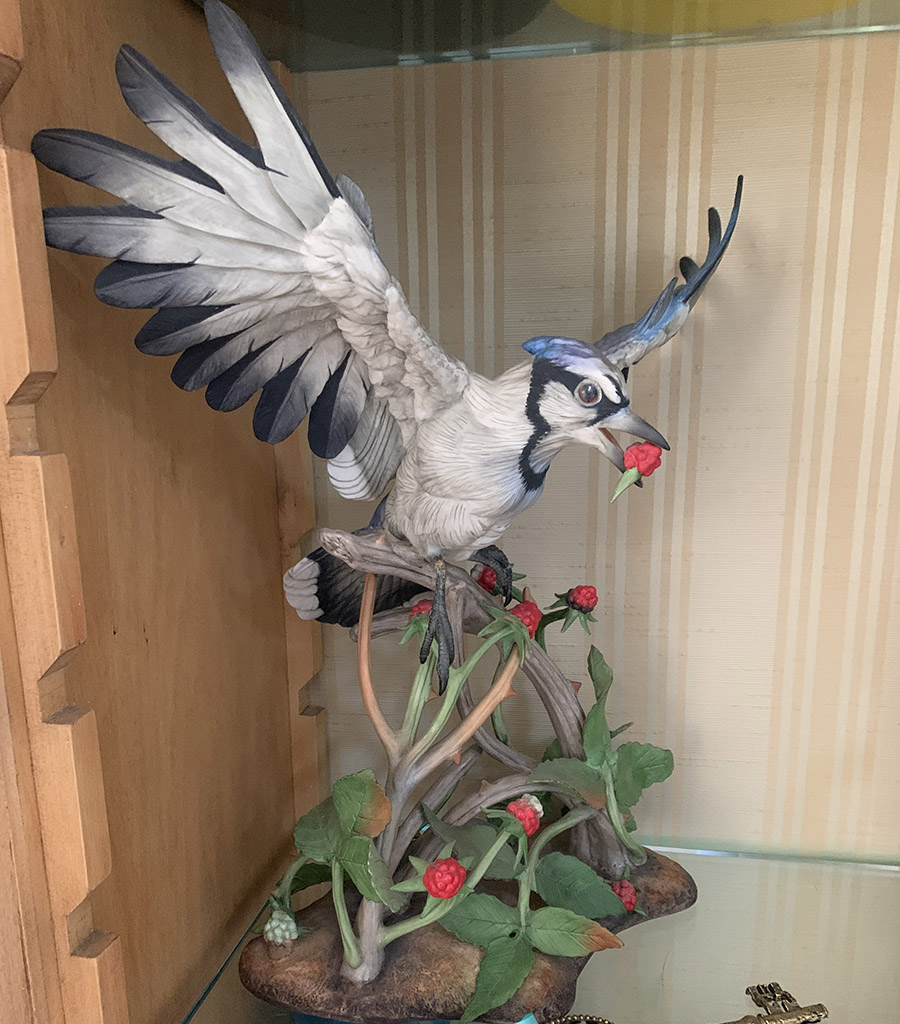
 EG sent me a photo of a magnificent seventeen and a half inch porcelain Blue Jay perched on raspberry branches. Its brilliant plumage modeled in hard-paste porcelain and hand-painted with extraordinary precision. Created in the late 1960s by Edward Marshall “Ted” Boehm (1913–1969), the sculpture immediately transported me back to childhood.
My mother longed to collect Boehm porcelain during the 1960s. My father admired the sculptures but thought them extravagant purchases. He often substituted less expensive copies produced by the Japanese firm Lefton China for special birthdays and anniversaries. The most American of all realistic art forms, porcelain figurines were assessable to almost all budgets, but not Dad’s. In the 1960s small animal pieces like the White Mouse Preening (issued 1957–1961) originally retailed for $15.
Smaller animal/bird figurines like Rabbit with Bow (issued 1957–1961) debuted around $7.50. More intricate bird sculptures retailed between $25 and $100. I still remember Mom’s treasured large scale Boehm rabbit. She bought it from Marshall Field’s downtown Chicago and sneaked it into the Deerfield house. This Blue Jay brought those memories flooding back.
Almost Anyone Owned a Boehm
Considered middle class “classy” in those days, it looked “real.” Once among America’s most coveted porcelain sculptures, many pieces now sell for a fraction of their original prestige. This particular Blue Jay, despite its remarkable craftsmanship, will likely bring no more than $500 at auction.
Ted was born in Baltimore in 1913. His father left the house at that time and he lost his mother at the age of seven. At the age of seven neighbors arranged a place for him, as a military school student trading work for studies, at Maryland’s McDonogh School, originally established for orphaned and impoverished boys during the Civil War. He learned farming, animal husbandry, horsemanship, and practical trades. Animals became his lifelong companions, and he studied animal draughtsmanship wandering in the school’s 830 acre grounds.
Boehm Became Fascinated With Porcelain
After studying animal husbandry and farm management at the University of Maryland, Boehm apprenticed with the American sculptor Herbert Haseltine, a bronze sculptor of some fame. Unlike Haseltine, he modelled no human creatures, and began with birds.
Unlike many wildlife artists who worked from taxidermy birds, such as John James Audubon, Boehm studied living birds, establishing an aviary on the shores of the Maryland River. He observed bird movements and didn’t kill specimens. In fact his aviaries became known for raising species never before raised in captivity, earning recognition from the Audubon Society. Every feather, posture, and tilt of the head in a Boehm sculpture reflects countless hours spent watching living birds. He died at his aviary at the age of 55. His wife, Helen, became his canny business partner, personally presented First Lady Mamie Eisenhower with one of her husband’s sculptures in porcelain. After Mamie praised his work, Ted became an American success story! Helen found markets for Ted’s works of art in America and courted European buyers, beginning at the top with gifts to England’s Royal Family.
International Recognition Came Quickly
By the 1960s his porcelain birds graced the china cabinets of many upper middle class homes in America. Today his work resides in the Metropolitan Museum of Art, Buckingham Palace, and the Hermitage Museum. The Vatican Museums named one of its museum wings after Edward Marshall Boehm, the first American ever to receive such recognition.
Perhaps his finest achievements were his large-scale studies of North American birds. The Blue Jay before me captures not only brilliant color but also personality. My problem is that none of my children think it’s worth keeping.
I’ve always loved Blue Jays myself. My cabin at Lake Arrowhead sits near the little community of Blue Jay. Blue Jays are remarkably intelligent members of the crow family. They cache acorns, helping spread oak forests across North America after the last Ice Age. They recognize one another by the distinctive black brindle markings around the face and throat, remain closely bonded to family groups. According to the Cornell Lab of Ornithology, mamy live well into their twenties. That knowledge somehow enriches Boehm’s sculpture. But not for my kids. Even harder to sell are the elegant, at the time, collector’s plates, finished in gold, with images of American birds. Boehm is considered lowbrow today, not categorized as art but tchotchkes.