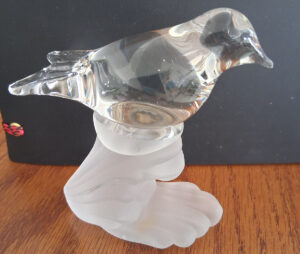
 AF owns a small clear crystal bird figurine on a frosted glass base. The underside shows a label “Made in Taiwan R.O.C.” (Republic of China). The phrase “Made in” helps date the piece. Exporters used marks reading “Made in Taiwan” after 1949 to distinguish Taiwan from mainland China, the People’s Republic of China.
AF’s acquisition of her little crystal bird is credited to the establishment of the mid-20th century neighborhood gift shop, a feature of every small-town square. I remember Sally’s Gifts of Deerfield Commons in Deerfield Illinois where I grew up. Sally, who purchased the objects, watched over the constant flow of bric-a-brac. My mom Elinor received a few ornamental crystal birds, bells, and teacups from Sally’s at the corner of Deerfield and Waukegan roads.
Giftware Boom
These small glass bird figurines, commonly produced in Taiwan, came to the U.S.-based company Silvestri between 1970 and 1990. The industry peaked in popularity during the 1980s when giftware boomed and shopping centers commonly featured gift stores. Silvestri remained a strong brand until the late 1980s, suffering the decline of the whole “gift” industry in 2000. Alco Standard acquired privately owned Silvestri in 1986. In 1987 Silvestri’s management bought the company back. In 1993, Fitz & Floyd purchased it. After filing for Chapter 11 in 1996, Silvestri later spun off to Syratech, which filed for bankruptcy in 2005. The brand subsequently sold and resold until 2007.
Today, the inexpensive gift store and those inexpensive gifts formerly sold, 1970-2000, are not hot property. Most vintage Silvestri items sell for under $20.
The local gilt store was once popular and also seasonal! Imported glass, plastic, and ceramic small objects lined the shelves. People coveted brands like Fitz and Floyd and Silvestri. Places like Sally’s Gifts used their own engraved boxes and bags with the store’s name. Sally or her daughter hand wrapped the gifts. Hard to imagine the merchandise exported to these small shops across the country 1970s-1990s.
1970s Through About 2000
Taiwan became a major exporter of giftware, plastics, electronics, and textiles, creating wares for companies like Napcoware and Silvestri that dominated the gift and Christmas collectible market, with Silvestri becoming a key player in glass figurines. Silvestri had its very name to thank for it success. it echoed the prestigious Italian glassmaker Creazioni Silvestri. Makers like Lalique of France represented the high end of the market. In 1980 a four-inch Silvestri bird might cost around $15, while a Murano Silvestri figure went for $400 or a comparable Lalique crystal bird cost $500. Today Silvestri Arte Murano of the late 20th century in a figural form, such as a lion or a horse, will cost $2,000 and up, and Lalique from the mid-20th century cost $800 and up.
Import Laws Change
Dating items by their markings is possible due to U.S. import laws. Before 1890 imports weren’t required to carry any country-of-origin marks. The McKinley Tariff Act of 1890 required imported goods labeled with their country of origin, though not necessarily with the phrase “Made in.” Items marked only with a country name typically date from 1890 to 1914.
In 1914 U.S. law required the phrase “Made in” to appear in English along with the country name. For example, Japanese goods originally showed the mark “Nippon” until 1921, when U.S. Customs required the use of “Japan.” After World War II, markings included “Made in Japan” and “Made in Occupied Japan” until 1952.
Political changes also affected markings. Items labeled “Czecho-Slovakia” date to the 1920s. German goods marked “U.S. Zone” typically date from 1945–1950, with later items reflecting East or West Germany. The German glass industry also shifted into Poland after World War II border changes.
By the mid-20th century, Taiwan and Hong Kong dominated the inexpensive giftware market. From 1949 until the mid-1970s, the U.S. did little trade with mainland China, so items marked “Made in Republic of China” or “R.O.C.” indicate Taiwanese origin. Goods marked “Made in People’s Republic of China” became more common only after trade resumed in the late 1970s.
Other country names also help with dating: Indonesia (established 1949) and Malaysia (1963) indicate more recent production. Most items marked “Made in China” date from the 1970s or later, though some are reproductions. Be cautious—fake markings existed throughout the 20th century. Items stamped simply with “China” and a generic character mark may be reproductions.
Pingback: Boehm Art Middle Class “Classy” - Elizabeth Appraisals