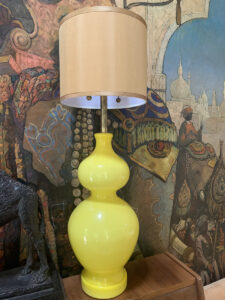
 A matched pair of glass lamps standing three feet tall combines the history of glass, the color yellow, and the 20th century stylish designer lighting. An object contains worlds!
Two entrepreneurial Pacific Coast brothers, Morris and Elliot Markoff, both born at the end of the 19th century, manufactured the lamps. Their company, Marbro, a combination of their last name and “brother,” based at the corner of Main and West First Street in Los Angeles lasted till 1990.
The brothers became known for designs incorporating the best materials for their lamps. In this case Venetian Murano glass born in Italy. They also sourced alabaster from Italy, Chinese and Japanese porcelain vases, German and French crystal, and brass from India. Considered high-end, they produced these lamps in a huge variety of styles and period designs. They employed a team of seamstresses to handcraft shades as well. A pair of these lamps today will set you back $2,000-$3,000.
Yes, the lamps are bright yellow
Knowing the interior design trends in this color helps us date the lamps. The shape, kind of “Op” art inspired, and the deep yellow-to-greenish-undertone neon, points to the early 1960s. Four distinct eras didn’t “fear” using bright yellow for interior accents. One, the birth years of the lamps. From the mid-1950s to the mid-1960s, designers used that neon yellow for decorative objects, with fabrics in geometric patterns, and paint colors.
Working backwards in time, the period post-WWII in both England and the US saw decorative accents in bright yellows. Some say the optimism brought by the end of the war created a desire for the “spirit-lifting” color. The yellow decorative objects produced for the mass market in the 1940s didn’t appear subtle in form, nor “high end,” and came affordable to the working class. In fact, Lawrence Levine’s seminal book Highbrow/Lowbrow: The Emergence of Cultural Hierarchy contains a section on such ornamental objects.
In the 19th century many types of glass and ceramic products, including Victorian oil lamps, came in bright yellow tones. From the most subtle to the most vivid tones of yellow in glass, specifically, amber, an old color, one that uses metallic silver for pigmentation. Think 17th–19th centuries stained glass windows. A departure from that subtle touch of yellow, the 1830s saw development of Uranium glass. Almost neon with undertones of green, made from a pigment of uranium oxide, a glass that fluoresced as bright neon green under UV light. Many people suspect radiation from this color of glass. In fact, the most pursued article at the Museum of Radiation and Radioactivity deals with the potency of this color glass.
Next in the line of vivid yellow glass is Vaseline glass, made popular in the Depression years. Not a true yellow but a green-yellow, also fluoresces neon green under black light.
Glass Technology Developments
Technology around yellow-toned glass developed in the late 19th and early 20th centuries. Both opaque and clear, such as cased glass, created in two separate blown-glass layers in two tones—one color, usually white, as the underlayer. Burmese glass, a matte yellow with an underlayer of a peach-color. Yellow milk glass, tempered by a white-pigment, and all types of vessels in yellows flashed with a metallic hue. Remember prizes at early 20th century fairs, “Carnival Glass.”
Since I painted the kitchen in my 1962 Santa Barbara condo a bright yellow, I felt happy to discover I’m in “style.” The design world experienced a shift from cooler tones such as blues, greys, and blue-blacks to yellow-tinted neutrals, all the way to my color, Citric Yellow.
Yellow In the History of Design A Recurring Favorite
Some tones suggest both tradition and nobility, such as gold yellows. Likewise the subtle cream yellows used on walls at Sir John Soane’s Museum, established by the great Regency architect Sir John Soane in London, 1813, suggest highbrow class. Contrast this with the yellow loved by Mrs. Flade in her collection of garish bath ceramic figurines. Take Mrs. Flade’s split-level house down the road in Deerfield where I grew up. Her bright yellow ceramic cute fish on the bathroom walls, her yellow ceramic soap dish, and handmade yellow crochet toilet paper cover. Long live yellow!