 In the last three weeks I’ve received two calls for two major doll collections of hundreds of dolls each. Readers know I’m frightened of dolls. When I attend an appraisal of a collection with all those lifeless faces and immobile eyes, I dream about them for a night or two.
A doll in a dream blends tenderness, family heirloom thoughts, and strangeness all at once. In the case of the doll collected by EE from South Africa, I see a difference between a doll as a toy and a doll as a sacred object.
EE’s Doll Comes From the Ndebele People
This prominent Bantu-speaking ethnic group in South Africa is located in the area between Zimbabwe and South Africa. A division of the Nguni peoples in historic times, such as the Zulu and the Xhosa, settled in the Transvaal in the 16th and 17th centuries. The Ndebele formed in the migration in the 19th century to Bulawayo, Zimbabwe.
The people are patriarchal, centered around family homesteads called kraals, and specialize in cattle herding and maize farming. One of the ancestral traditions of the women of the tribe involves the creation of these beautiful abstract dolls. They represent certain important moments in female lives, such as an initiation doll, a bride doll draped with beads over her face, or a sangoma doll, which represents a diviner with her contact to ancestral spirits. She’s a protector of society, allowed to have firm opinions, or a modern creation: a Rasta doll.
A Courtship Ritual
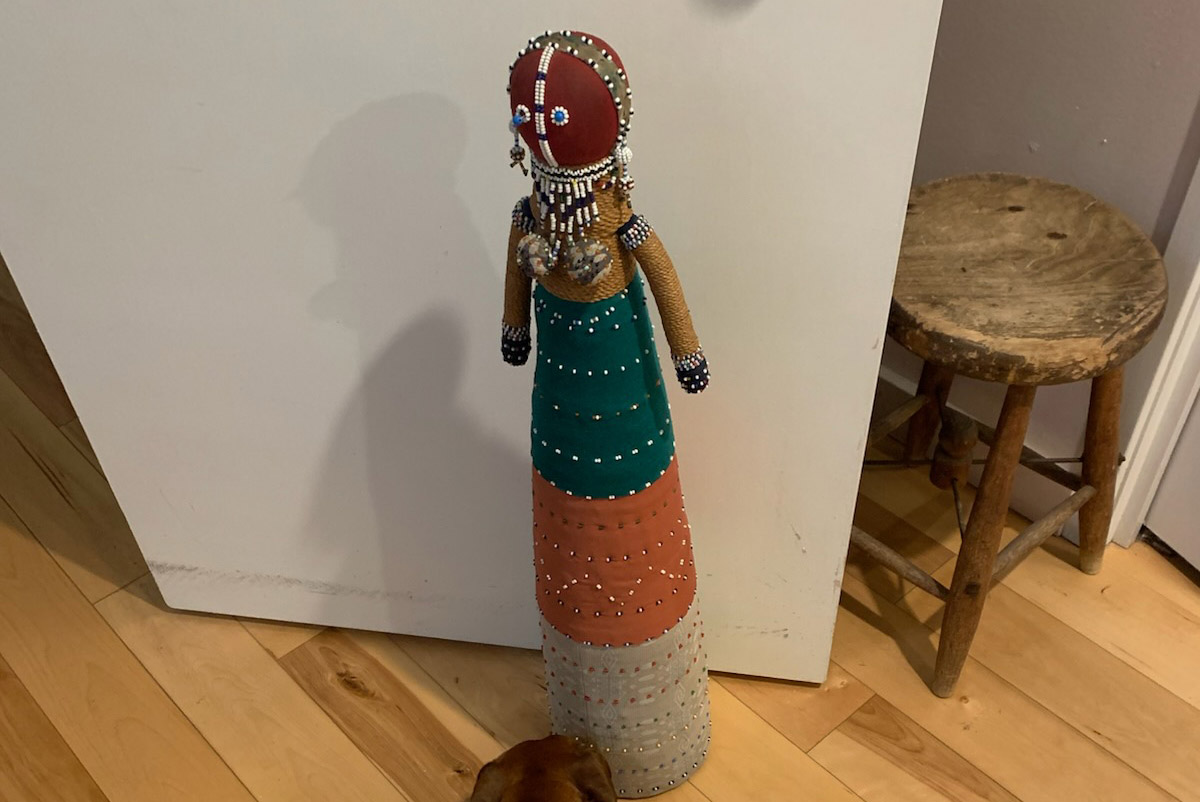
EE’s doll is a ceremonial sangoma doll that indicates the desire for marriage and used in courtship rituals. A suitor placed this doll on the threshold of his intended’s family hut, indicating his intention to propose marriage. These ceremonial dolls are grown women with round, individual sculpted breasts with beadwork.
On the DeeBeeGee’s Black Doll Museum site I read about a similar Ndebele doll. The “Linga Koba” female doll, the ‘long-tears doll,’ goes to a middle-aged mother after her teenage son’s initiation rite to become a man. Dolls created by the Ndebele are one of a kind. I found some beautiful comparable sales on the websites of Indigo Arts Gallery in Philadelphia and DeeBeeGee’s Virtual Black Doll Museum.
This is the ceremonial doll which likely figured in many girl’s dreams throughout Ndebele culture. They kept this doll that preordained marriage in the house to encourage fertility.
The sheer size of the forty-five inches tall sculptural work of art with detailed fiber and beadwork ornamentation implies permanence. They’re handcrafted by Ndebele women only. The tall, conical-shaped doll with round, ball-shaped head is constructed of a rigid core wrapped in plant fiber, ornamented with geometric seed beads, making up hair, necklaces, and fringes. The implied costume represents her status and holds meaning. Notice it shows her breasts but not her feet!
We see a division line down the middle of her face where you might expect a nose. Her neck appears long and often ornamented by copper and brass neck rings worn by tribeswomen to stretch their necks. A long neck symbolizes beauty.
EE collected this in the area formerly known as Zulu territory in South Africa. EE also brought back a beaded, intricate bride or wedding apron created on sheepskin, worked with glass beads in an abstract design.
Back To My Dream Of This Doll
It triggered childhood memories of visiting the Seminole Nation as a kid and collecting a lady doll in the 1970s made of cloth and beadwork. It also stirred some adult anxieties related to control, outward appearances, and growing older.
Girls “watch” ceremonial dolls in female form as a role model in the performance of a role. In this case, through courtship and marriage, approached slowly and with dignity. A doll such as this holds a secret, a mask, presents an ideal. As a ritual object it’s “displayed,” used in storytelling, as education, as an emblem of continuity and the dignity of one’s female ancestors. The doll is a 20th century version of an ancient craft valued at $500.