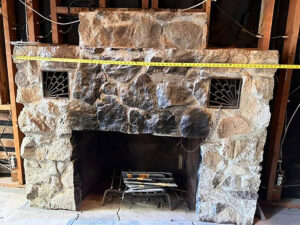
 PE recently purchased a tiny “fixer-upper” cabin in the San Bernardino Mountains near Lake Arrowhead and Big Bear Lake. During the remodel he discovered the 1,660-square-foot cabin originally built in 1919 came with an addition completed in 1927. He sent me an image of the fireplace in the main room, currently under construction. He asked whether the fireplace and its treatment date to the original 1919 structure or the 1927 addition. This question spans two distinct eras of design, the Arts and Crafts style of 1919 and the Deco style of 1927.
Art Deco Elements
Unmistakably, PE’s fireplace is a rustic, somewhat amateurish interpretation of an Art Deco design, far removed from Deco’s birthplace in Paris. The design is Deco. The materials are not. The first clue lies in the cast-iron vent covers. Known as Heatolator grilles, they circulate air and protect the firebox from excessive heat. These vents appear quintessentially Art Deco: flat, geometric, symmetrical compositions featuring zigzags, chevrons, and sunburst motifs.
Art Deco designers embraced repeating geometric forms to express modernity, speed, and forward movement. By contrast the fireplace’s material, the local light gray granite and white quartz of the San Bernardino region, says anything but modern. This stone, likely formed during the Precambrian era some 300 million years ago, grounds the piece firmly in deep geological time.
Undeniably Deco
Yet the form of the fireplace is undeniably Deco: square, angular, and assertively modern, anchored by a simple rectangular mantel. It’s an endearing rural interpretation of a Deco fireplace. If you imagine this same form reconstructed in black-veined Carrara marble, polished to a mirror-like sheen and paired with those Deco grilles, you easily envision a refined Parisian example.
PE’s modest mountain cabin, infused with international Deco elements, stands in stark contrast to late 1920s glamorous Deco apartments of Paris, New York, Miami, and Los Angeles. In those urban settings a similar fireplace appeared taller and more monumental. Set within ten-foot walls, it featured a dramatic mural, perhaps sleek, sculptural female figures rendered in a stylized modernist idiom. One certainly never encountered the charmingly “glamping” version PE uncovered.
The Arrowhead fireplace, with its planar surfaces and Deco ornament, demonstrates how one of the first truly international design movements resonated at 5,500 feet above sea level in 1927. It’s entirely possible the architect responsible for the cabin’s addition worked in the Los Angeles Deco high style of the late 1920s.
Art Deco Born In Paris
Art Deco’s defining moment came with the 1925 Exposition Internationale des Arts Décoratifs et Industriels Modernes, a landmark world’s fair of design and architecture. The pavilion designed by Émile-Jacques Ruhlmann captivated visitors. The oval grand salon featured soaring twenty-foot ceilings, silk wall coverings inspired by Egyptian motifs, an amboyna and ebony grand piano, and a monumental black-veined marble fireplace. A mural of parakeets and stylized nudes, illuminated by a chandelier cascading with crystal spheres anchored the fireplace. Edgar Brandt, whose work helped define the Deco aesthetic, created the fireplace’s metalwork.
Brandt later worked in the United States, including New York City, where he designed an extraordinary set of metal doors for the Belmont Building on Madison Avenue. Like the anonymous Arrowhead designer, Brandt often incorporated Egyptian-inspired relief patterns, stepped, faceted forms influenced in part by the 1922 discovery of Tutankhamun’s tomb.
Thus, the persistence of the modern Deco style in the 1920s traveled far beyond Paris, finding expression in a small lakeside cabin in the California mountains. Here, the builder used local stone to interpret an international style, resulting in a uniquely regional take on Deco in 1927.
The Question Remains
Do you like it? PE’s fireplace may be a hybrid, but is it a good hybrid? In my opinion, the main problem is the squat of the fireplace. It might have a higher hearth for proportion. When performing a remodel the question is, does PE stick with the period. If so WHAT period of design should guide PE’s decisions? The Deco flair, or the rustic earthy rugged look of the stone. BOTH exist in this one fireplace.
For added interest, PE also shared before-and-after images of the fireplace following sandblasting. He welcomes any thoughts on the remodel. Perhaps he’d welcome extra period furniture, lighting, or tile. To reach him, email me.