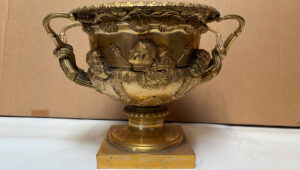
 PP sent me a large drinking vessel, a replica of the Warwick Vase. Collected in the early 20th century on a 19th century grand tour. Wealthy young men on their lively bachelor tours of Europe collected classical bronze works of art. They brought back decorative objects as trophies, along with the usual portrait painted of that handsome rich young traveler by an eminent Italian artist.
I believe this bronze gilded vessel is French, likely from the era of Napoleon III (1860-80), likely collected on the continent. No sculptor’s mark nor foundry mark appears on it. But I did see a number etched in to the metal of the base verso. This shows someone cataloged it for their personal collection. Although not English, blue bloods in 18th and 19th century England coveted this style.
Yes, I Called This A Drinking Vessel
Inspired by the first Roman god of the vine, Greek Dionysus/Roman Bacchus. The Bacchic motifs seen on the vase are masks of Dionysus, leopard and lion pelmets (Dionysus’ sacred felines), and vines, bodies covered in vines, and handles of intertwining wine branches. The rod that crosses the front between the masks is the Thyrus, the emblem of the god, a staff topped with what appears like a pine cone. If you look close you see the presentation of phalli, also found in many cities that honored the god.
Dionysus/Bacchus himself would feel proud of this bronze punch bowl. He himself collected drinking vessels, bringing back a silver goblet from his conquest of India. There was always something foreign about this god, and something feminine. However, nothing feminine, so they say, about the first owner of this archetypal first century marble drinking vase or punch bowl, the first Emperor to sport a beard, Roman Emperor Hadrian (100AD).
The Glasgow Museum in Scotland houses the original, rare, marble vessel, called the Warwick Vase, a treasure almost eight feet high. Scottish Neo-Classical painter, archeologist, and savvy dealer of Greek and Roman antiquities Gavin Hamilton (1723-1798) found the vessel in fragments. He discovered it in 1769–1770, while excavating in the silts of Lake Pantanello on the grounds of the Villa Tiburtina. The villa of the Roman Emperor Hadrian (117 to 138) stands outside Rome. The vase, likely created in ancient Tivoli, Italy, adorned the villa gardens. A monumental marble sculpture in the form of a two-handled drinking cup decorated with masks and motifs relating to the cult of the Roman god of wine, Bacchus/Dionysos. George Greville, Earl of Warwick, bought the vas for the courtyard of Warwick Castle. It stood there almost two centuries until the Scottish Heritage Association purchased it for The Burrell Collection in 1979.
An Ultra-Sexy God
From the 18th century onwards the rediscovery of the Warwick Vase provided a major source of inspiration for the Neo-Classical school in the decorative arts in Britain. It bridged the millennia between Classical Antiquity and 18th century taste in Britian and Europe. Look at Dionysus’ laughing face placed around the vessel, offering wine, song, dance, and debauchery.
Dionysus/Bacchus was slightly foreign, slightly androgynous, ultra-sexy god of theatre, panthers, donkeys, and goats. Also the god of regeneration and vegetation, pleasure, madness and collective ecstasy. His cult was a Mystery Cult. Only the initiated participated in rituals, which involved days of revels, mainly carried out by females. Dionysus/Bacchus cults practiced sexual liberation. The god himself participated in both heterosexual and homosexual relations. His favorite boy being Ampelos, who died riding a wild bull. The god transformed him into a vine and a constellation in the sky, making him immortal, writes Ovid, the Roman poet, born 43 BC.
Examples of objects from antiquity featuring Dionysius/Bacchus were found in India, Serbia, Greece, and Italy. The god is represented in many forms, none more famous that the Warwick Vase. PP’s bronze is a late 19th century copy, not in marble, like the original. But cast in bronze with gold overlay gilding. Sotheby’s sold one very similar for $2,700 in November 2012. Since this is an older comparable sale, I estimate the value of the bronze at $3,000 today.