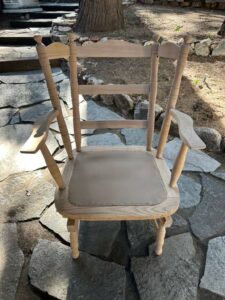
 RR inherited a chair with a four-post back. Her grandmother called the chair Amish. She asked me to verify the origin. The form shows some Shaker or Amish elements, but for the most part it falls into the category of Americana legacy furniture. My mother called this “Colonial-style” furniture, made in the 1950s. Twice in the history of Americana this style became popular. In the late 19th and early 20th century craftsman Wallace Nutting made this furniture famous. Then in the mid-20th century Colonial Revival furniture companies, such as Ethan Allen, brought this style in vogue. This chair falls into the second period.
RR, it’s not Amish. The key characteristics of 16th to 18th century Mennonite, Shaker, and Amish furniture are geometric plain lines, no veneers, late medieval-style mortise-and-tenon joinery, no metal hardware or hinges, and no particle board. Furthermore, the primary woods used are white oak, brown maple, cherry, elm, and walnut. RR’s chair, now that she refinished it, appears made of pine or, at a stretch poplar.
No Branding or Craftsman’s Signatures
Furniture builders didn’t make these pieces for the community nor mass-market appeal. RR, you should know that a great Amish chair from the early 19th century will set you back five figures or more. Amish 18th century furniture in this style will cost even more, especially if it’s from the “early schools” of Jonestown or Soup Hollow in Pennsylvania. Take a look at the delectable furniture offered by dealer Jeff Bridgman Antiques in Lancaster County, Pennsylvania, for a taste of real Amish furniture.
Yes, RR, your chair is in a Shaker or Amish style because of the ladder back and the innovative “ears.” We see those flanges at the side of the head he Amish version of the English and Early American wing chair. I found such chairs as yours offered today for $1,150 on the website DutchCrafters. They advertise the furniture as handcrafted in Pennsylvania, although the company itself is located in Sarasota, Florida. They definitely made this furniture for the legacy market, reproductions of older styles. Today’s legacy companies capitalize on reputation of Amish and Shaker furniture as timeless and for the piece’s superior handmade craftsmanship, one of a kind pieces. However although RR’s chair bears this legacy, it doesn’t live up to this quality. Still, Amish legacy companies such as DutchCrafters offer Amish style and Mission style pieces, such as a large desk, for $6,500 and down.
Variations In Chairs
Wing chairs, RR’s chair is a variation, originated with an unknown carpenter. He designed them to sit in front of the fireplace, the only source of heat in a 17th-century room, in order to retain heat around the head and protect it from drafts. In France they called these chairs bergère à oreilles, “shepherdess with ears.” No one knows who first conceived the idea, but you see wing chairs in their heyday during the 18th century in leather, tapestry brocade, and cotton upholstery. Eventually in the 20th century we see the most amazing modern versions, such as Danish Modern designer Arne Jacobsen’s Egg Chair.
Today’s chairs often have foam-density padded tie-on cushions. If this were an original 19th-century Amish chair, made for an older relative or infirmed individual, expect to see natural-fabric cushions with drop-in, loose, or tie-on adjustable forms stuffed with hay, horsehair, or cotton wadding. However, most Amish or Shaker chairs don’t have cushions. A joke goes: “Yes, you will feel that hard seat. But your wallet will feel significantly flattened in your back pocket after the purchase of an original Amish or Shaker chair!”
Second Wave Of Discovery
Shaker and Amish chairs were first “discovered” and popularized in the late 19th and early 20th centuries. The sparse and linear aesthetic blended nicely with the American Arts and Crafts furniture style, known here in California as Mission style. The second wave of rediscovery came in the mid-20th century during the Colonial Revival period, think Ethan Allen. Our house was filled with the stuff.
I believe Towne Square Company made your chair. They mass-produced these “quaint” legacy chairs in the 1950s. The value today is negligible. Perhaps a light, definitely not dark, wood stain, and fitted adjustable cushions, would raise the value to around $350. I wish I could report your grandmother was right, and you have a $5,000 chair, RR.