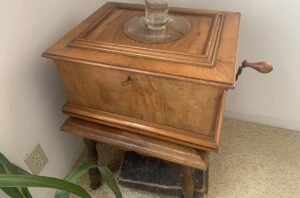
 LB owns an 1898–1902 Symphonion crank-operated tabletop music box. It spins perforated seven-and-a-half-inch steel discs on a double-comb movement patented in Leipzig by Symphonion Musikwerke. The photograph shows a bound album beneath the player which originally contained twelve discs. The music on these discs tells the story of an era, a sentimental era of marches, waltzes, and traditional hymns.
Researching the titles of these discs, I find German folk songs, operatic melodies, and astoundingly, American Ragtime. What drove the manufacturer of this Leipzig music box to commercially market uniquely American Ragtime, popularized by Black musicians centered in St. Louis Missouri?
Both my parents with roots in Germany spoke German as I learned English. I can read the Gothic German script stamped on these discs. My eyes widened at titles such as “Us Gwine Back to Dixie,” “Plantation Song,” “Little Alabama Coon Dog,” “Oh Honey, My Honey,” “It’s a Great Big Shame,” “Smokey Joe’s Cakewalk,” and “Where Sweet Magnolias Bloom.” The latter two identified by Ragtime scholars at the Library of Congress as dance music sat alongside discs entitled “Von Herzen zu Herzen” (“From My Heart to Your Heart”) and “Klosterglocken” (“The Monastery Bells”).
Ragtime and Waltzes
Ragtime’s syncopated rhythms bound together with Strauss waltzes? Yes! Because by the end of the nineteenth century Ragtime swept both Europe and America as a commercial sensation. The craze began in the mid-1890s with the booming market for Ragtime sheet music, which in turn fueled sales of upright pianos. At first many older Americans viewed Ragtime with suspicion while younger audiences in both Europe and the United States embraced it enthusiastically.
These tabletop music boxes sold for about $12 in 1900. In St. Louis, where three generations of my family were raised, a middle-class salary ranged from $600 to $1,200 per year, while working-class families earned about $400 to $600. A music box truly stood as the jewel of the parlor.
Some of the discs in LB’s album contain Ragtime melodies with the characteristic “ragged” or broken melody line played over an insistent rhythmic bass. At the 1893 Chicago World’s Fair popular performers introduced millions to what became known as the Missouri Ragtime style with its staggered foot-thumping beat. Nearly twenty-seven million people attended the exposition.
When played today these angelic-sounding steel discs still capture the energy of Ragtime’s irresistible propulsion in two-four time. A looseness founded on its “short-long-short” feel makes me think of it as a limping rhythm. That swing became immensely popular in the high-stepping Cakewalk, often the finale of a minstrel show. Not every American paterfamilias wanted to see his daughters dancing to such rhythms! Young Americans danced in their parlors when their parents were safely out of the house.
Spirit on a Music Box Spinning Steel Discs
Library of Congress Performing Arts Reading Room reports that music boxes became vehicles for families to discover music as diverse as German Lieder and Missouri Ragtime. The purchased of box and discs came with an option to order additional discs. Although thirty cents each seemed expensive in an era when a loaf of bread cost a cent. The era delighted in attaching “time” to musical forms: Waltz Time, March Time and, of course, Rag Time—underscoring a rhythmic beat as the marker of musical time, a heredity of Jazz and eventually Rock.
Conservative early 20th century listeners associated Ragtime with saloons, brothels, minstrel shows. Also the bustling “Gateway to the West,” St. Louis, where north-south river commerce fostered an extraordinary cultural melting pot. My St Louis grandmother, who lived under Bevo Mill, regaled me with stories of shows along the levee. Some of America’s greatest Ragtime composers emerged there, bringing with them a new rhythmic language that soon crossed the Atlantic. Listening to the delicate tinkling of LB’s music box today, it takes some imagination to hear the thumping syncopation of a Ragtime piano. The Leipzig engineers captured its spirit on a spinning steel disc.
Because LB’s Symphonion is a mechanical device the steel discs are susceptible to rust. Values vary considerably. A restored music box with twelve or less original discs generally commands between $350 and $1,500. Yet, to me, the real value lies in hearing German Romanticism and American Ragtime share the same music album. This serves as a reminder that when my grandmother was born in 1901 in St. Louis, music became an international language.