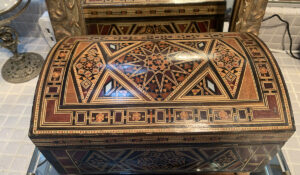
 HH owns a large jewel box that encompasses three cultural styles across ten centuries. Yet it’s neither rare nor particularly pricey. This vintage handmade inlaid box draws from the traditions of Moroccan, Syrian, and Spanish woodworking artisans. How is this possible, and why can’t this appraiser locate its origin exactly?
This box speaks of the exchange of art, culture, and craftsmanship between Moorish Spain (Al-Andalus) and North Africa, often called Hispano-Moorish or Hispano-Maghrebi. The connection extends all the way to the opposite end of the Arab world in Syria. The box’s design spans a cultural loop dating back to the Arab-Islamic Empire, the world’s largest land empire from 632 CE to 1258 CE.
Golden Age of Islamic Tile and Mosaic
This box contains hints of the Umayyad Caliphate (661–750). Their woodworking answers why this object is described as both Damascus and Hispano-Moorish work. The Umayyad Caliphate, which likely originated this style of craftsmanship, became the first major Islamic dynasty based in Damascus, Syria. The style spread throughout the entire Arab-Islamic world and continued under the long-lived, culturally rich, multicultural Abbasid Caliphate, centered in the City of Peace, Baghdad, Iraq. These artistic traditions ultimately reached Spain during Moorish rule from 711 to 1492.
The box itself reflects the Golden Age of Islamic tile and mosaic work. The intricate geometric inlay derives from an art form perfected in the Arabic-Andalusian architecture of the Alhambra. My brother lives in Spain about two hours from this wonder of the world and arranged a private tour for us—the highlight of my last forty years! Our entire group of four siblings, assorted spouses, and children crammed into a minivan to travel to the palace. I thrilled to see echoes of Santa Barbara in the Alhambra. Even the road from Málaga to Granada reminded me of the hills of Santa Ynez.
While the rest of the family admired the grand vistas and discussed where to eat lunch, I photographed door hinges, carved wood ceilings, and geometric tilework. At one point I believe my relatives lost track of me entirely. They discovered me studying a decorative panel with Paul, my engineer brother and David, my culturally diverse brother of seven languages.
Another Layer of Cultural Relevance
This style tradition is part of our style tradition, too. The same Hispano-Moorish influence that shaped the Alhambra centuries later influenced design throughout Southern California, especially Santa Barbara.
The box may also have its origin story in either Granada or Córdoba, both centers of this type of tile and wood inlay. Traditional woods used in Southern Spanish and North African boxes include cedar, walnut, and thuya, often inlaid with mother-of-pearl, bone, and, in earlier examples, ivory.
After Moorish rule in Spain ended during the Reconquista, and Jews and Muslims fled. Many settled in Morocco, where they preserved and perpetuated Andalusian design principles. In Morocco, marquetry boxes such as HH’s took on the flair of Berber design traditions, adding yet another layer to their cultural story.
I pulled together all the elements of wood marquetry, intarsia inlay or taracea, the intricate honeycomb patterning, known in Islamic architecture as muqarnas, or stalactite decoration. HH’s box is a clearly 20th-century Nasrid Revival lidded box drawing inspiration from the final Islamic dynasty of Spain, the Nasrids. The box is also part of the late 19th, early 20th century Hispano-Moorish style we know so well in Santa Barbara. This style drews its breath from that era’s Romantic Revival in architecture and design.
The box is worth approximately $500.