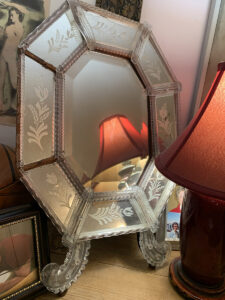
 DD sent me a 19th century etched and blown-glass dressing table mirror, angled on an easel back. She asked about the history of “self-reflection” and its value.
In the Golden Age of Greece people treasured a mirror. Socrates instructed his students to gaze at themselves. Diogenes quotes the great philosopher as saying: “If ugly, become learned to overcome this limitation. If beautiful, become humble to be worthy of your beauty. Avoid pride, and use the likeness you see as a tool for self-improvement, beautiful or ugly as you may be.”
Another philosopher, over 2,000 years later, Charles Horton Cooley, developed his theory of the “looking-glass self.” He believed mirrors help us form an identity because we become, in part, what we believe others see. Some fifty years later, Dr. Seuss intuited the name “Horton” in Horton Hears a Who!, where Horton the elephant asks, in effect: “Am I an elephant, or am I a speck of dust?”
Mirrors in the Early Days
DD’s two-foot-tall mirror harkens back to the image of a fine lady seated at her dressing table, preparing for the day. She needed only a mirror large enough to reflect her face and décolletage while her maid dressed her hair and fastened her jewels. In its day, the second quarter of the nineteenth century, we didn’t see mirrors mounted on bathroom walls over the sink. I consider that twentieth-century innovation a design mistake. Let me count the earrings I’ve lost down the drain. Give me a dressing table and DD’s mirror.
Before 1835 mirror manufactures used the extraordinarily toxic element mercury. They backed a sheet of rolled glass with tin foil, fused with mercury to create a reflective surface. The fumes claimed the lives of workers in Murano as Venetians perfected the mirror. Venetian mirror and glass guilds swore their members to secrecy. Due to the dangerous and expensive process, only noblemen and kings afforded Venetian mirrors to furnish great “palaces of power,” such as Versailles. Mercury-backed mirrors also lacked longevity. Over time they became cloudy as the mercury slowly settled downward with gravity.
Long before the invention of Venetian mercury mirrors, humankind already discovered ways to see itself. The earliest evidence of a reflector was simply a polished basin filled with shallow water around 6000 BCE. Succeeding generations experimented with polished volcanic glass, burnished brass, and copper until the ancient world discovered methods of backing glass with reflective metals.
Mirror-making Changed Dramatically
In 1835 Justus von Liebig developed the process of depositing silver nitrate onto glass. DD’s vanity mirror belongs to this new era of mirror making.
To mark the 250th anniversary of the American Revolution, Historic New England restored a remarkable mirror for its exhibition, Myth and Memory: Stories of the American Revolution, at the Eustis Estate in Milton, Massachusetts. Mirrors larger than two feet seemed like exceptional luxuries, fashioned from hand-rolled, rippling glass. Nearly four feet tall and imported for the owner through London, it prompts an intriguing question: How did such a large, delicate, glass-framed mirror arrive in America before 1776? What kind of wealth did its owner possess? And what kind of vanity? In 1740, the journey from England to the American colonies typically took between six and eight weeks. However, depending on wind conditions, severe weather, or the ship’s route, transit times could easily stretch to twelve weeks or more.
The mirror belonged to a Loyalist colonist. When those who remained loyal to King George became enemies of the State after the Revolution, many fled to Canada or England. Their possessions were confiscated and auctioned at the site of today’s Boston City Hall.
Thus DD’s vanity mirror, with beautifully blown-glass ornamentation, and delicately etched glass florettes, was far more than a utilitarian dressing mirror. Her mirror, an intimate luxury, took a place of pride on a fine dressing table. Today this style of mirror, considered fussy and small, is overlooked and underappreciated. Its silvered backing naturally deteriorated with age, diminishing its reflectivity.
To the modern eye it appears little more than a battered old mirror in an era when even the restroom in the average airport concourse offers a flawless mirror stretching above every open-mouthed sink.
This mirror comes with a current fair market value of approximately $150. Ironically, adjusted for its rarity and cost of manufacture, it represented a far greater luxury in the mid-nineteenth century than its modest value suggests today. Sometimes an antique’s greatest value lies not in its price, but in the remarkable story reflected back at us.