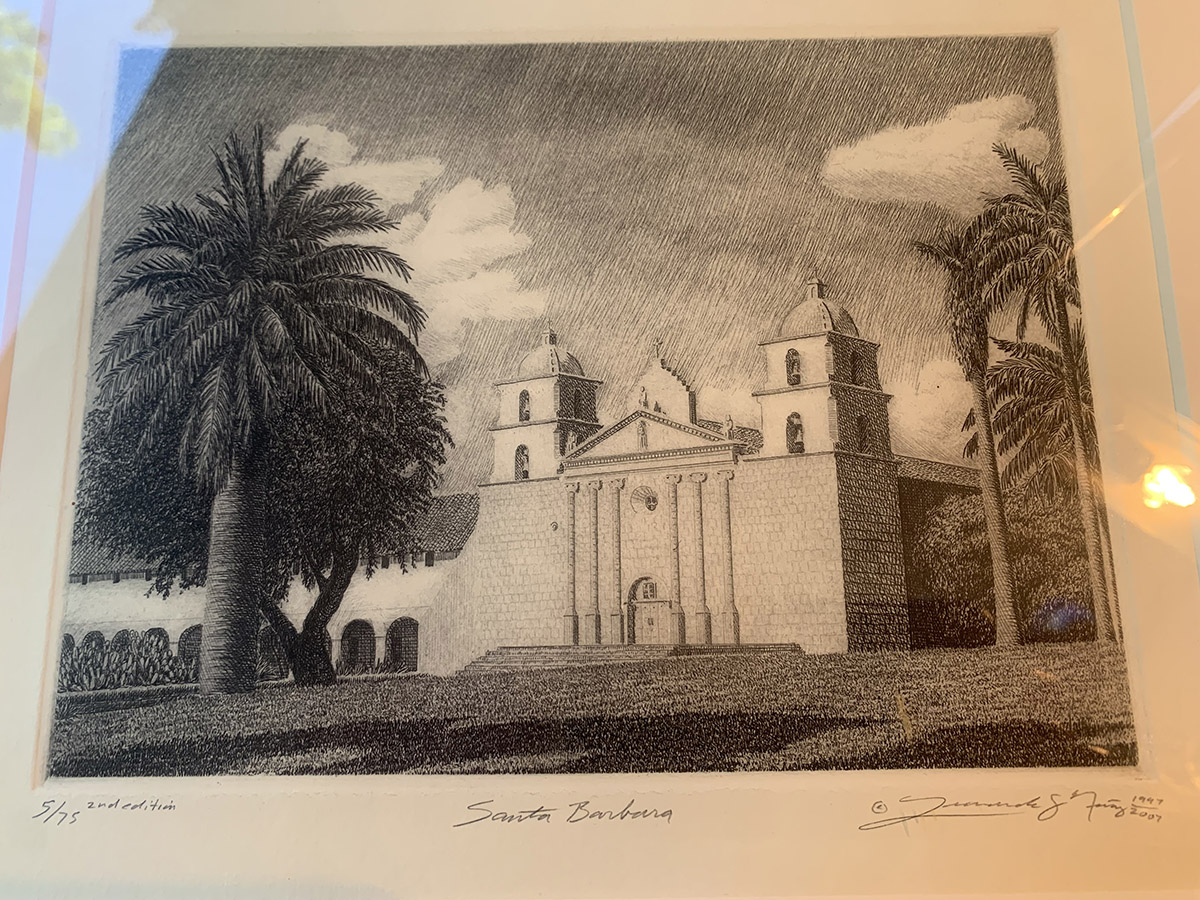
 LS inherited an etching of Mission Santa Barbara, signed in pencil “Leonardo Núñez, 1997/2007” with markings for a second edition, the fifth strike of 75 prints of the Mission. The image measures six by eight inches showing the façade of our Santa Barbara Mission with her iconic palms.
This image by Núñez is one of the Lompoc artist’s “Las Misiones de Alta California” series. He made the original intaglio prints from copper plates using the historic processes of etching and mezzotint. Mezzotint is my favorite print technique. A printmaker “roughs” the copper plate so its basic state holds a saturation of black ink. Instead of cutting into the copper plate to produce black lines, the technique of mezzotint is reductive. Areas meant to appear lighter are smoothed in the copper plate itself. This results in monochromatic tonal shifts on white paper of dramatic greys-blacks, for example, the black of the palm tree in the foreground.
Núñez’s Impressive Task
Núñez etched twenty-one Missions, 1995–2000, all Franciscan Missions down the north-south corridor of El Camino Real. This history of the Missions began on July 16, 1769, at Mission San Diego de Alcalá. Our Santa Barbara Mission became the tenth Mission dedicated, on December 4, 1786. Santa Barbara Mission stands in a cluster of Missions: San Buenaventura in Ventura, Santa Inés in Solvang, and La Purísima Concepción in Lompoc.
According to a 2007 article by Emily Welly in the Santa Maria Times, the artist exhibited his Mission etchings in a show called Tradition and Transition in 2007 at the Betteravia Gallery. They hung alongside historic etchings of Missions by Henry Chapman Ford (1828–1894).
Núñez, an impressive artist, worked in differing scales and media, from small-scale etchings to murals. He executed the eighty by fourteen foot Randolph Mansion Mural at the first Mayor of Lompoc’s residence for Lompoc in 1995.
La Purísima An Inspiration
Núñez became interested in creating a series of California Missions when working on his Lompoc mural. Growing up in the area, La Purísima was a favorite haunt. Lompoc’s first Mission, formerly at the end of South F Street, was destroyed by an earthquake in 1812. They rebuilt it at the existing location. Sadly it sold in 1834 and became a ranch, abandoned, then the Civilian Conservation Corps restored it in 1941.
Due to his love of La Purísima Mission, he created the series of Missions. He visited each Mission repeatedly, began with on-site sketches, studied the shading for his eventual mezzotint prints. He spent about three weeks per plate, and completed in roughly five years. His limited first edition, the number of the same prints in each of the series, included three hundred. LS’s comes from a second edition, a series of seventy-five.
Awarded his MFA from UCSB, Núñez volunteered teaching art at the California Youth Authority’s Los Prietos Boys Camp. The artist’s biography sourced from the impressive little The Annex Gallery in Santa Rosa, states that Núñez is a master at reduction-color linocut prints. He crafted some delicious wine labels, as well as a master of mezzotint etchings, oils, and acrylics, a career of forty years.
Marcia Burtt Gallery on Laguna Street in Santa Barbara holds many of his etchings of Missions for between $110–$170.
Other Mission Artwork
LS, your inherited image of Santa Barbara Mission isn’t the first time a Mission is the subject of fine art. I recently finished an appraisal of a donation to Mission San Buenaventura by the British artist Edwin Deakin, who from 1897–1899 painted a series of twenty-one oils of each Franciscan Mission (1769–1823).
Another client gave a work by Henry Chapman Ford (1828–1894) from the series in an original edition of fifty of each to the Santa Barbara Historical Museum. Ford ran a Santa Barbara studio from 1875–1894. He published a series of what was then thought of as Romantic Ruins, with the Missions in complete disrepair, in 1883. Ford’s portrayal of the Spanish-style Missions in peril sparked an interest in “ruins tourism.” Train schedules advertised these tourist outings leading to restoration efforts for some of our Missions. Ford’s work contributed to the Spanish Colonial style so familiar in Santa Barbara.
Finally, a contemporary artist, M. Stewart Hansen, painted a series of Missions.
LS, your etching is worth $170.