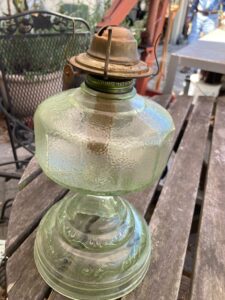
 This little green kerosene lamp proves a point. Objects possess much the same uncanny property as the old theory of “six degrees of separation.” The principle suggests that any two people on Earth are connected by no more than six social relationships.
An object carries the memory of its maker, its owners, its travels, and its purpose through time. Objects tell us who they are. They unite people through their own narratives, if one gets curious enough to ask them their history.
Researching this kerosene lamp did far more than identify a manufacturer or establish a value. It introduced my Santa Barbara client, JT, to Don and Kay, owners of the historic Plume House Inn in Thomaston, Connecticut. A lamp sitting quietly on a California table reached across 2,460 miles and more than a century to reunite itself with its birthplace.
JT’s lamp is late nineteenth-century pressed-glass of pale uranium green, with a rounded front. On the brass burner I see stamped “P&A Risdon, Danbury, Conn.” The “P” stands for David Scott Plume (1829–1907), an inventive Connecticut Yankee whose improvements to the humble brass burner helped illuminate America before commonplace electricity.
Plume Prospered
His success enabled him and his partners to build one of Thomaston’s grand houses overlooking the Naugatuck Valley. Today that house survives as the Plume House Inn, lovingly operated by Don and Kay. Each guest room displays lamps fitted with Plume burners and clocks made by Plume’s business associate, Seth Thomas. When I located the owners of Plume’s former home, two families whonever met found themselves discussing the history of one little lamp. The object introduced them.
That’s what antiques do at their very best. They connect us not simply with history, but with people.
Plume’s company flourished after the Civil War. They manufactured brass burners, lamp fittings, knobs, and caps, while supplying brass fittings for oil-burning lamps, heaters, and chandeliers. By 1906 the firm’s catalogue devoted seventy-eight pages to lamps and fittings alone: wall sconces, hanging lamps, banquet lamps, student lamps, table lamps, and every imaginable fitting. Between 1871 and 1912 the company received sixty-two lighting patents. Plume’s partner, Lewis J. Atwood, obtained forty-four patents of his own.
Plume invested in a brass rolling mill near Danbury, Connecticut, that manufactured burners and clock parts. There he collaborated with clockmaker Seth Thomas of Waterbury, supplying brass components for Thomas’s growing clock business, which became a household name. Plume’s factory also produced the famous “Eagle” lamp burner that held the wick. People continued to use P&A burners well into the twentieth century. As late as 1910, Americans purchased glass kerosene lamps fitted with P&A burners.
Tragedy Struck In 1955
The company, having relocated to Thomaston, was devastated. The great Naugatuck River flood destroyed bridges, factories, homes, railroad lines, automobiles, livestock, and machinery throughout the valley. Remarkably, the company survived and continued manufacturing lamps into the 1970s.
It’s difficult today to imagine lighting a lamp each night. Electricity arrived far more slowly than we realize. In 1910 only a small percentage of American homes had electric service. Even by 1935 much of rural America still relied on kerosene because electric companies considered country homes too expensive to connect. Franklin Roosevelt‘s Rural Electrification Administration finally changed that. When I was born in the late 1950s some places in America still used kerosene lamps as practical necessities.
JT’s lamp, complete with its original P&A burner, has a value of approximately $150. Yet its greater value was introducing two families separated by 2,460 miles. It reminds us that the humblest household objects, those that live with us every day, often carry the richest stories. It’s not the great painting that tells the richest story, but the lowly objects that live with us daily. Functional objects, they’re called. In the case of an oil kerosene lamp, its function is now obsolete in our world of electric gadgets glowing with blue screen light, yet it reminds us of a kitchen in Connecticut lit by its warm yellow glow in 1871. Today its function is secondary to its story: a reminder of an America before electricity, and of two families, separated by two coasts, brought together in 2026 by one small lamp.