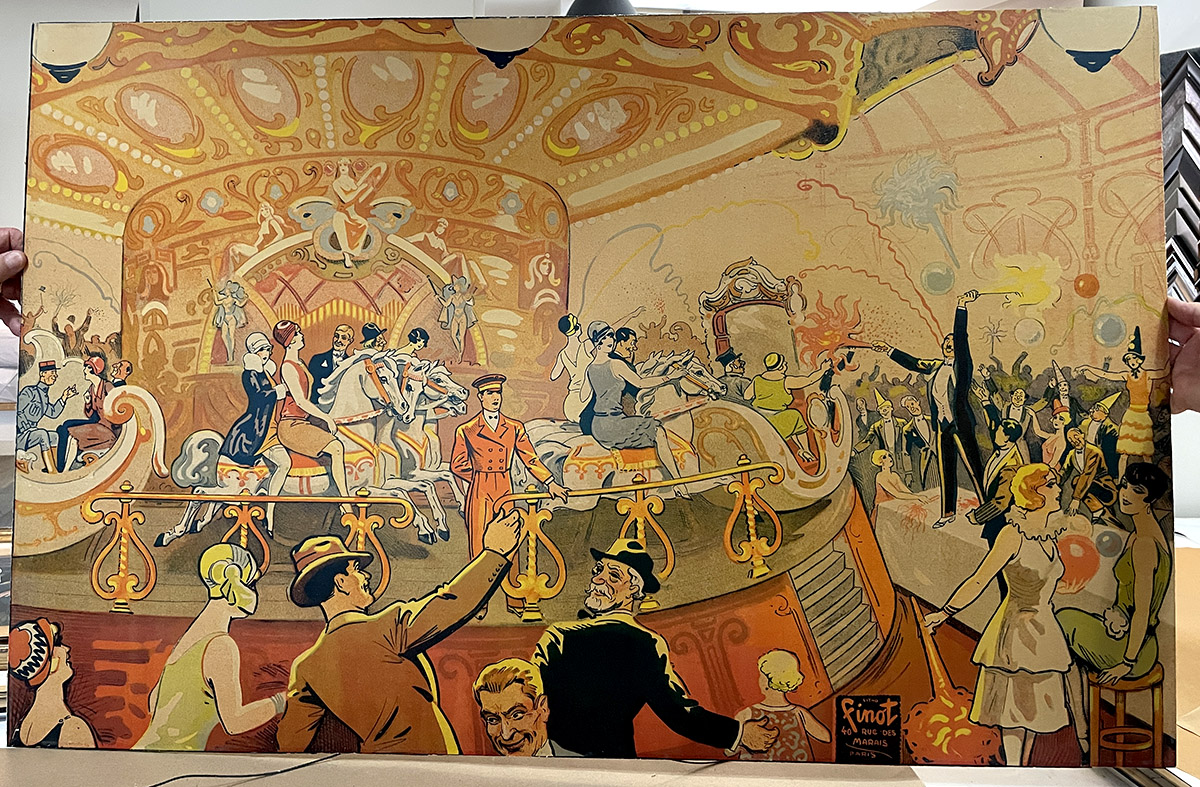
 This week FF sent me a French advertising poster with the narrative theme of enjoyment at the circus. Well-dressed 1930s crowds enjoy a carnival, (buy your tickets!) signed Émile Finot. The Art Nouveau lithographer became wildly popular with his first advertising poster, Eureka Les Troubadours in 1905.
The term “Narrative Art” sticks in my mind with the opening of the Lucas Museum of Narrative Art in Los Angeles. The museum’s mission: “to explore how narrative art shapes our world, expresses beliefs, communicates values, expands imagination, and invites conversation.” They organized their galleries around themes such as Comics, Children’s Stories, Fantasy, History, and Community, naturally including material from Star Wars and Indiana Jones universes.
George Lucas built an empire by understanding the same visual storytelling principles that Finot, Mucha, Toulouse-Lautrec, and other poster artists pioneered 170 years ago.
Posters Persuade, Inspire, and Sell
Advertising posters, which entered the design world in the mid-nineteenth century, are a means of mass communication using art, history, and design. They’re aimed toward popular culture and consumption, promotion of a product or event, propaganda. I’m fascinated to see if the Lucas Museum of Narrative Art will include great advertising posters of the late nineteenth and early twentieth centuries, as well as the iconic propaganda posters of the two World Wars. These works occupy a pivotal place in the history of narrative art. Like the imagery of Star Wars, designers created these to persuade, inspire, and sell. The medium changed, but the underlying principle did not: a powerful image coupled with a compelling story sells a point of view, a product, a myth….
George Lucas understands better than anyone the extraordinary power of visual storytelling. Star Wars films generated more than $10 billion at the worldwide box office, while the broader franchise—including toys, books, home entertainment, games, and licensing—exceeded $46 billion in estimated revenue. Those remarkable figures illustrate a simple truth: images that tell compelling create emotional connections that people remember, collect, and purchase.
Long before movie franchises, artists like Jules Chéret, Henri de Toulouse-Lautrec, and Alphonse Mucha designed lithographic posters to sell theaters, bicycles, travel, and consumer products. Their posters became advertisements, certainly, but they were also visual stories. They invited viewers purchase into that glamorous world. George Lucas created a museum devoted to narrative art because narrative imagery is among the most powerful forces in culture. The same principles that made Star Wars a $46 billion franchise also made the nineteenth-century advertising poster one of the great artistic inventions of modern life.
Narrative History of Storytelling in Images
In many respects, the nineteenth-century advertising poster and the twenty-first-century movie franchise are close cousins. Both rely on memorable imagery, recognizable characters, and carefully constructed visual narratives that invite viewers to participate in the stories they tell. FF’s poster sold the circus, or the newly invented bicycle, War Bonds, or champagne. Star Wars likewise sells a mythology. George Lucas simply elevated the advertising poster into a global narrative universe, memorialized in a museum
Narrative art shows a moment in time, a sequence of events, evokes the past, present, future. Artists who creates narratively rely on the mono-scene, a frozen moment or a sequential scene. They tell through a series of panels, as does a Marvel comic book or film sequencing of a movie. The vocabulary of narrative work, as is the vocabulary of the early advertising poster, consists of characters, settings that determine time and place, and cultural symbols. Viewers are acquainted with these symbols as part of the storytelling.
A narrative visual language in art remains one of the most enduring forms of communication, from the three-panel screen behind an altar, to the Japanese scroll, to the modern comic book, to movie posters. Western art was primarily narrative until the twentieth century, through religious images, and images from myth and history. Middle class collectors in nineteenth century loved paintings of everyday people. These are termed “genre” paintings. This is the period of the birth of the advertising poster. Narrative art flourishes wherever images communicate ideas, evoke emotion, and tell stories on the streets of Paris in 1895 or in a galaxy far away.
Intent of the Artwork Heart of the Question:
Because art “sells” something, is it art? FF’s circus poster, circa 1930 France, is a memorial of a time when entertainment, a village circus, created its own special, simpler universe. It’s worth $500 to collectors of vintage advertising posters.