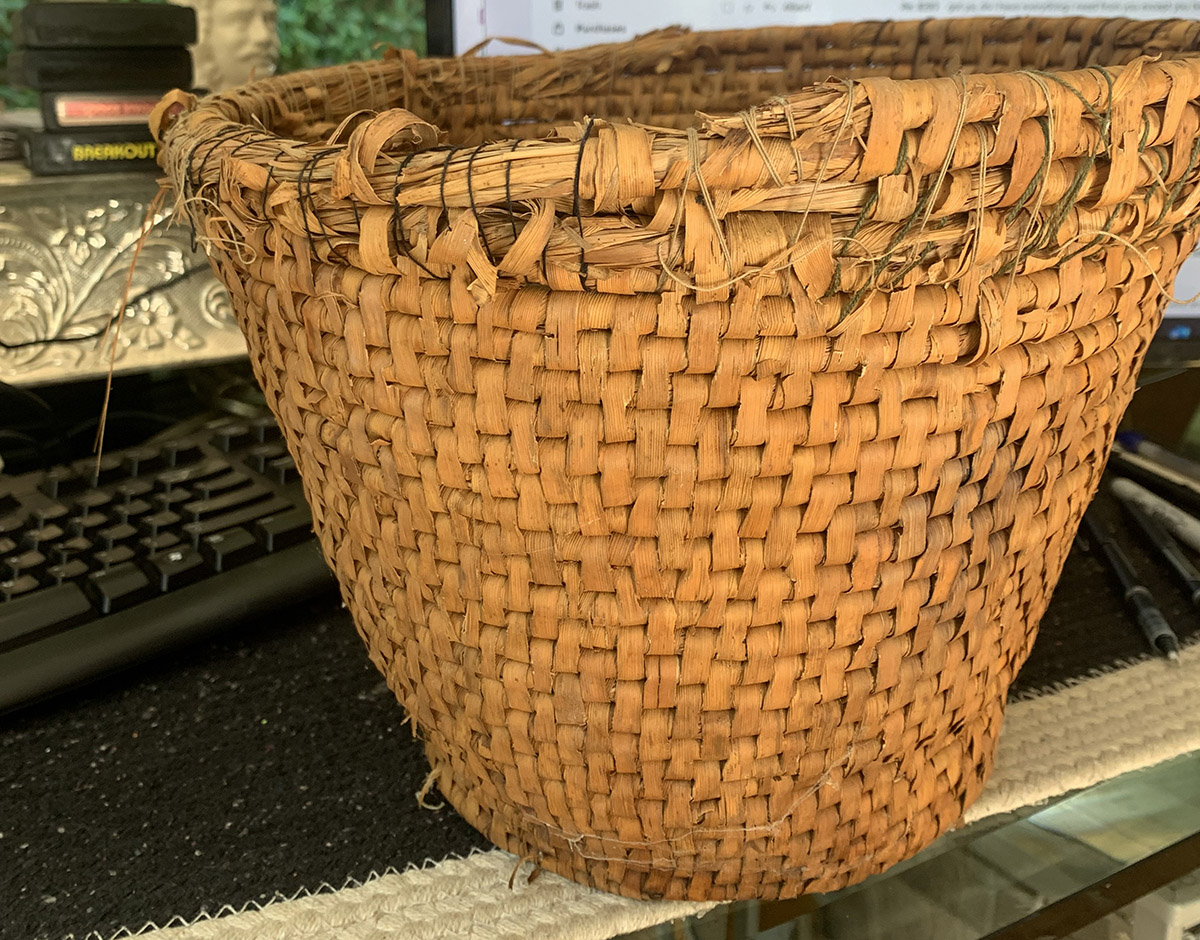
 My grandmother lived in a small house under the shadow of the BEVO Mill, a reproduction windmill housing a famous brewery on Gravois in Saint Louis. I grew up there in the area called Dutchtown. Our family didn’t come from Holland. We came from Bavaria on my grandfather’s side. Locals often referred to German immigrants as Dutch, because some spoke a dialect called Deutch. We owned this basket, a Stroh Karreb – straw basket. For many years we didn’t know its origin as 19th-century Pennsylvania Dutch, made of rye straw from the areas around Bethlehem and Allentown, Pennsylvania.
Many Uses For Rye
Germans in Europe loved rye, considered a cereal crop. But it created many things like rye whiskey. They prized it for filling mattresses, insulation under carpets and walls, and stuffed horse collars. They used rye as drinking straws, and, of course, basket making.
Men, women, and children, no matter how “moral,” all drank rye whiskey in the 18th century. In fact, from a bushel of rye, a community enjoyed eleven quarts of whiskey. When they harvested the rye crop in July, half the workers fell down drunk in the fields. The other half, not drinking, hauled those light-eyed, fair-skinned blondes out of the sun into the shade. What a hangover.
The German immigrants from Rhineland-Palatinate used rye straw for thatched roofs when a structure didn’t require a chimney. Each week, they pulled many loaves of rye bread from the Pennsylvania Dutch beehive ovens. The thatched roofs seemed practical with no shingles and no blacksmith to make nails.
This Basket Tells Story of Germans in Lehigh County
The first group of German immigrants to Pennsylvania arrived in 1683 aboard the ship Concord. They established a new life rooted in religious freedom, shaping the early history of the Pennsylvanian Dutch, founding Germantown.
This basket is likely from the 19th century. This style of coiled basketry binds and wraps the long straw rye fiber. This form of cellulose resists decay and mice dislike it, too. Once the straw is threshed to release the grain for the whiskey and bread, basket makers reap and bundle the rye. They coil a long rope of rye straw all the way from the bottom of the basket to the top. Goschenhoppen historians still teach the tradition.
These rye straw baskets became breadbaskets, sewing baskets for wrapped balls of old fabric for quilting, for beans, dried schnitz, things that did not require handles to carry—light work baskets. The Goschenhoppen historians of the Henry Antes (1830s) plantation of Perkiomenville, PA, are a superb resource. The group documented the Dutch frugally working the farm communities of the 18th century. A lecture is forthcoming called Ordinary Days in Revolutionary Times: The Lives of the Pennsylvania Dutch 250 years ago.
Once the community entered the mid-19th century, the area became known for Pennsylvania Dutch zinc and copper miners. But the farming tradition continued. Whether Lutheran, Reformed, or Mennonite, the community all broke from their work to celebrate the harvesting of the rye. They called it “Harvest Home,” based on ancient Celtic and Saxon traditions. Before George Washington issued a proclamation in 1789 creating the first Thanksgiving Day designated by the national government of the United States of America, the Pennsylvania Dutch were celebrating the Harvest Festival, the gathering in of rye amongst other crops.
The basket itself is entirely functional, as it’s deep, with a 1:1 height-to-width ratio, a perfect volume to hold small crops as a gathering basket. The half-bushel basket is formed in a plaited checkerboard weave, and the rim top has been repaired. I see somebody formerly reinforced it with wrapped fibers.
Another Theory
This basket may have been created in the 19th century by a member of a Native American Eastern Woodland tribe—Cherokee or Iroquois. They used baskets for berry gathering. The Pennsylvania Dutch grew cereal rye and used it for bread and whiskey, as well as roofs and baskets. Yet cereal rye originated in Asia, travelled to Europe then imported here. Wild rye grass, not a cereal, is indigenous to the Americas. Rye grass was bundled and coiled for baskets similar to mine.
Used for my brother’s trashcan, this is a rural folk-art gathering basket, likely Pennsylvania Dutch. I’ll write to the Goschenhoppen Historians to make sure.
The value, if so, is $500, even in this condition. If it’s found to be Eastern Woodland Native American, it’s worth far more.
So interesting and well written!