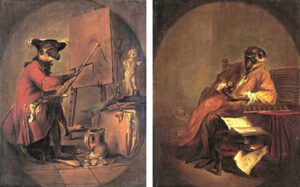
 Singerie, you say? Yes. DD owns a delightful group of color lithographs ‘after’ Jean-Baptiste-Siméon Chardin‘s celebrated Le Singe peintre and Le Singe antiquaire. One monkey is an artist, the other a antiquarian. Their dress is unmistakably upper-class, their surroundings refined, their actions entirely human, yet Chardin leaves no doubt that his subjects are monkeys.
Monkeys imitate human behavior, but therein lies the joke: we ourselves are primates, endlessly imitating one another. These images ask a larger question: What’s the relationship between our five senses, shared with all primates, and the cultural forces that shape how we see, hear, think, taste, touch, and smell? Are we political animals?
Monkeys In Art
The term singerie refers to centuries of monkeys in art, politics, and literature as parody figures—allegorical creatures lampooning one of humanity’s closest cousins: ourselves. The designer Christophe Huet (1700-1759) made the singerie a fashionable artistic genre, coveted by the upper class of France in the 18th century. DD’s lithographs are “after” Chardin, meaning, they are 19th century reproductions. They’re worth $250 each.
In Chardin’s prints we encounter a pair of post-Enlightenment monkeys. The Enlightenment celebrated the superiority of human reason, logic, and order over impulse, baseness, and immorality. Its message was simple: keep your vices in check through the power of reason.
Yet long before the Enlightenment, monkeys served as moral actors. The Sanskrit Panchatantra (ca. 100–500 CE), including the tale of the Curious Monkey, featured animal characters. Centuries later Aesop’s Fables echoed those stories. These anthropomorphic tales traveled westward along the Silk Road, eventually appearing in French and Italian literature. Brunetto Latini‘s The Book of Treasures (c. 1230–1294) likewise told moral tales conveyed through familiar and exotic animals.
This impulse to moralize through animals inspired the richly illustrated medieval bestiaries, which portrayed human folly acted out by beasts. Jan Brueghel the Elder‘s Monkeys Feasting (1620) depicts every imaginable excess of gluttony, drunkenness, vanity, and immoral revelry. Such allegorical tales abound: The Monkey and the Cat warns us to beware of flatterers who praise us for their own benefit. The Fox and the Monkey reminds us that a ruler unable to govern himself is unfit to govern others. Medieval writers attributed changing moods to monkeys: joyful beneath a new moon, melancholy during the full and waning moon. This shows a Freudian transference of human emotions to our ‘lesser,’ baser, cousins.
Animals As Vehicles For Satire And Moral Instruction
The Middle Ages witnessed the rise of royal menageries and private collections of both indigenous and exotic creatures. Naturally the nobility believed themselves separate from both common people and their animals. Civilization, refinement, and culture belonged to the upper classes. Instinct and disorder belonged to peasants and animals.
The painter Edwin Landseer captured this irony in The Monkey Who Had Seen the World (1827), portraying a white-faced ape wearing a red silk coat trimmed with braid and medals, a powdered wig on his head, elegantly smoking a long pipe while looking with disdain on his unclothed fellow primates. Landseer reportedly remarked, “A monkey in silk is still no less a monkey.”
Likewise, Antoine Watteau‘s La Peinture (c.1700) presents the monkey as a serious and diligent painter working at his easel. This reinforces the seventeenth-and eighteenth-century maxim ars simia naturae—art is the ape of nature. Artists imitated nature faithfully, mastering realism through disciplined observation in the academic tradition.
The celebrated linguist and explorer Sir Richard Burton (1821–1890), translator of both The Arabian Nights and the Kama Sutra, owned some forty monkeys while serving with the East India Company. He reportedly hosted elaborate banquets in which servants served his monkeys, claiming to study monkey language. Similarly, Charles Darwin‘s The Expression of the Emotions in Man and Animals (1872) narrowed the gulf between humans and other primates. By the nineteenth century, museum dioramas featuring taxidermied animals placed within carefully painted environments spoke of the “control” of the animal kingdom by the “top” primate, which, of course is us.
Singerie is far from dead.
Walton Ford‘s monumental watercolor The Sensorium (2003) imagines Burton’s famous banquet with his monkeys, questioning imperialism, colonialism, and racism—the lingering inheritance of nineteenth-century institutions. George Orwell‘s Animal Farm (1945) is a classic modern example of animals serving as mirrors of human political behavior.
Monkeys in art are classic examples of anthropomorphism. Traditionally, the ape stands “below” humanity, embodying foolishness, trickery, greed, vanity, and moral weakness. Or does he?