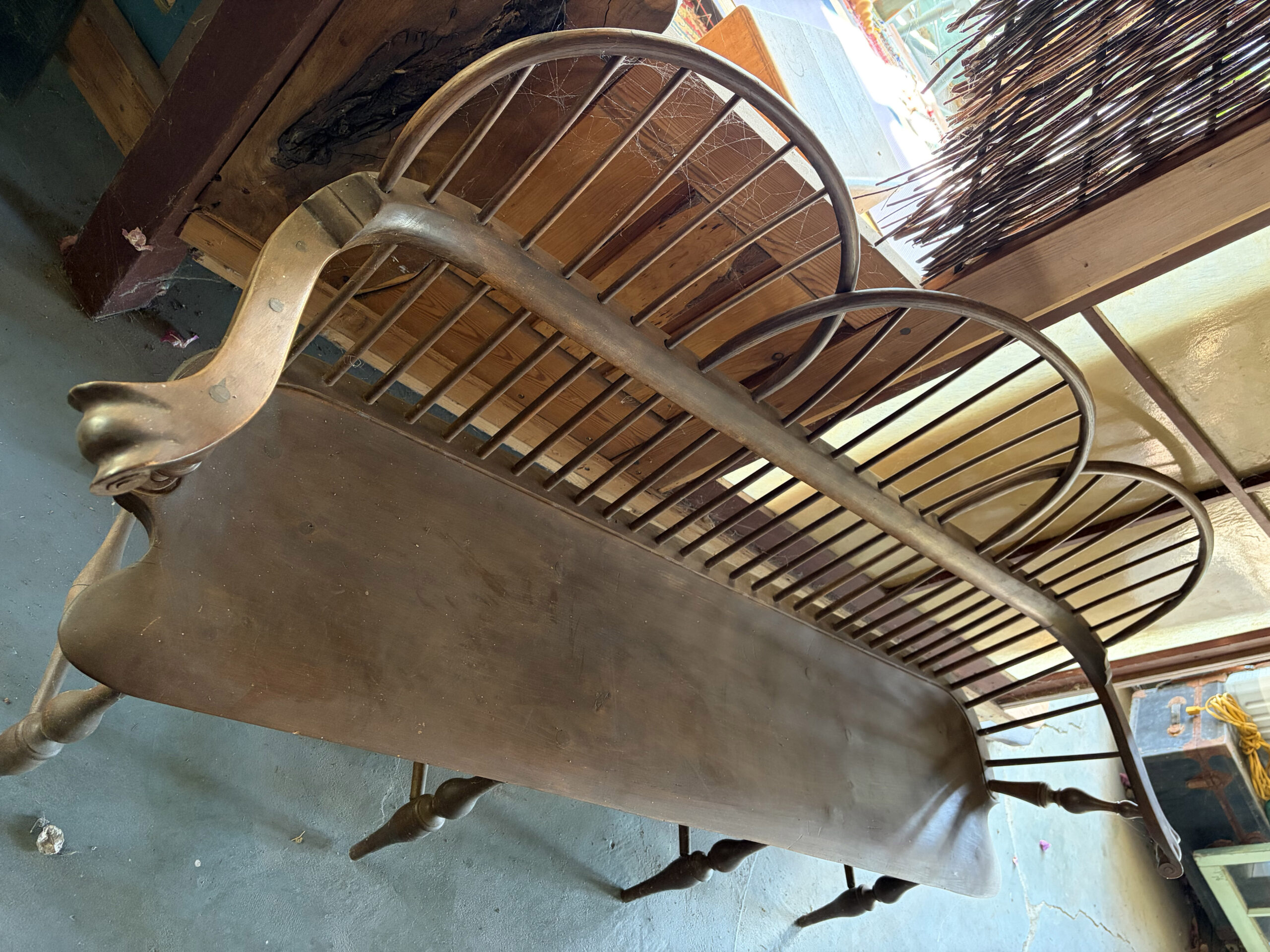
 KL owns a triple bow-back Windsor settee. At first glance it struck me as an example of 18th or 19th century Americana from the Mid-Atlantic states. This form didn’t especially appear in the grand capital cities of late 18th-century America: Philadelphia, Boston, and Newport. One found Windsor settees in taverns and wayside inns, in the “below stairs” quarters of large houses. Landowners wanted to seat three people without the expense of commissioning three separate Windsor chairs. At seventy-two inches long, the settee is one of the largest forms in the Windsor family.
Settees Put to Hard Use
Landlord used them wherever they wanted to seat three for the price of one: in taverns where travelers rested and drank or at dining tables where servants sat. It’s understandable that surviving examples are rare today. A New Hampshire bow-back settee sold for $20,000 plus, although I didn’t find a comparable example currently on offer.
Both America and England produced Windsor chairs in the late 18th and early 19th centuries. They served the middle classes on both sides of the Atlantic. More elaborate designs, such as American Chippendale furniture, generally went to those born to greater means.
Examples described as “museum grade” balloon-back American Windsors are offered on sites such as Chairish. The market prizes several features: an elegant, continuous slope from the bowed back into the arms, characteristic of New England examples. An original saddle seat, with its raised central area accommodated the sitter comfortably. Also desirable, an undisturbed surface patina, one never sanded, refinished, or painted.
Fine examples of a somewhat rarer variation include a modified bow-back Windsor with three spindles rising from the back and terminating beneath a shaped headrest. Fine New England examples, with graceful lines, strong provenance, and untouched surfaces, bring $8,000 to $10,000.
Prices For A Chair, Not A Bench.
Craftsman Doug Dimes, or possibly by his father, made the piece in the photo. Dimes, a second-generation Windsor-chair maker, based his workshop in Pittsfield, New Hampshire. The market doesn’t necessarily measured a reproduction’s value by how closely it competes with an antique. The work itself is judged by craftsmanship, tradition, and integrity.
Dimes’ father made authentic reproductions of American New England Windsor chairs in 1964. For the American 1976 Bicentennial, he produced Windsor writing-arm chairs, with a writing surface attached to the side, commissioned by Independence Hall in Philadelphia.
His work attracted commissions from the Smithsonian and Old Sturbridge Village. In 1990 his son Doug joined him for a commission for Windsor chairs from Colonial Williamsburg.
Sadly, in 1991 as Colonial Homes magazine prepared a feature on the artistry of the Dimes family, the workshop burned to the ground. This brought production to a halt. They constructed a new building by 1993. The business continued, including a 2004 commission for Windsors for the historic Charleston courthouse.
Fervor For Americana Began To Wane
Doug Dimes turned to finish carpentry. In 2018 he sold the business and returned to the family farm. Today he makes Windsor chairs much as his father did in 1964, working out of his barn.
If you wished to commission Doug Dimes to make a triple bow-back Windsor settee, you’d spend approximately $5,400 and wait eighteen weeks. The piece features the traditional maple turnings, oak bow and arm components, and a pine seat measuring approximately seventy inches long. Finishing options include traditional black or red crackle paint, with out-scrolled arms and “scrolled” knuckles, chair parts often named after human body parts.
KL’s settee, however, comes with an estimated Fair Market Value of $1,000 in the secondary market. Reproductions generally don’t retain their value in the same way as period antiques. You’ll pay more for a commissioned piece made by the master Dimes today.
Yet the Dimes settee presents an intriguing exception to the usual assumptions about reproductions, a piece made by a craftsman whose family devoted generations to the study and practice of a historic American furniture form. Its value lies not simply in its resemblance to an 18th-century original, but in the quality of its craftsmanship, the continuity of the maker’s tradition; it remains a usable example of a nearly lost regional art.
A reproduction may not command the price of an authentic settee, but a fine one occupies a class of its own.