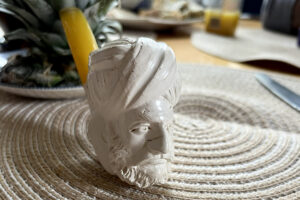
 LS wrote to ask if his vintage pipe is ivory. If so, can he sell ivory? First question: it’s not ivory. If made of ivory, LS would need to donate it. It’s illegal to sell ivory today without extensive paperwork. His 1880s sea-foam hand carved pipe is meerschaum!
Where did this tradition of carved meerschaum originate? What’s the figure on the bowl of the pipe? Notice the turbaned head, his bearded face. This answers the first question: carved meerschaum pipes originated in the mid-18th century in Eskişehir, Turkey, a region between Istanbul and Ankara. Today sepiolite, the material commonly known as meerschaum, “sea foam” in German, is mined from thousands of shafts leading to horizontal galleries, ready for extraction. Sepiolite is the remains of compressed ancient sea life. Scientifically, it’s a hydrous magnesium silicate.
Secondly, the pipe’s bowl features a Turkish gentleman, a nod to Turkish tobacco, long considered one of the world’s top tobaccos. A blend called “Oriental,” a small-leafed, sun-cured variety of the plant tastes spicy and tangy. Opposed to sweet, grassy leaves of Virginia plants from the United States. Thus, the image of the exotic man gives a nod both to the place of origin of meerschaum and the style of tobacco the pipe held.
From Turkey To Germany
In the 18th and 19th centuries Turkey exported meerschaum to Vienna for carving. Thus, the tradition of these pipes became associated with Germanic culture, with carved figures evoking distinctly Germanic aesthetic. Carving reached a height in the 19th century, when a wide variety of figures and bowls entered the world market, often with amber stems. Typical figures are dog breeds, bears and wolves, fat Friar faces, buxom women, sultans, sea creatures, Greek Gods, Arabian Princes, Trolls, and Sailors. Today master carvers in Virginia are represented on a charming site called MeerschaumMarket.com. Order a modern meerschaum pipe with shorter stem or a traditional “churchwarden” long stem intended to make the smoker look contemplative.
However, tobacco is native to the Americas. Smoking of tobacco pipes dates to Indigenous American ceremonial rites as early as 3,500 years ago. Archaeologists found early clay pipe fragments from this period. The plant emerged in Europe in the 16th century through several avenues. These included the 1492 voyage of Christopher Columbus and the Spanish conquest of the Aztecs who smoked tobacco. In 1586 Ralph Lane, the governor of Virginia, brought a Native American pipe to Sir Walter Raleigh and taught him how to use it.
Settlers at Jamestown smoked pipes of many sizes and shapes, as attested by extensive excavations conducted by the National Park Service beginning in 1933. Later at Williamsburg in 1963, workers found an entire pathway to a blacksmith’s house paved with 11,000 broken clay tobacco pipe fragments from the 17th century. The supposition is that pipe smoking became so popular with Colonists, both men and women, that the 11,000 pipe fragments represent a shipment from England damaged on the voyage. By 1580 England began producing its own white clay pipes, and the Guild of Tobacco Makers was established in London in 1619.
Imitation Meerschaum
In Turkey and Vienna in the 19th century imitation meerschaum pipes entered the market. Made from other minerals or a composite of meerschaum shavings, these imitations lacked the ultra-light, heat-resistant features, and didn’t naturally absorbent of nicotine tars. Some of the figures on the bowls appeared amateurishly carved or molded rather than hand carved. A moistened finger placed inside the bowl of a real meerschaum pipe will stick slightly to the sides because sepiolite is porous. Briar or ceramic pipes competed in the 19th-century market, but they didn’t age like meerschaum pipes. When newly carved, they’re bright white but over time turn amber, then red, and eventually a deep ochre. Sepiolite is rarest, and most valuable, when the material is translucent.
In 1970, Turkey banned the export of raw sepiolite nodules, traditionally carved in Austria or Germany. Today Turkey maintains a multigenerational tradition of hand carvers in Eskişehir.
When first purchased, around 1880, this pipe cost a lot. Today, like many materials related to smoking, it might sell for around $100.