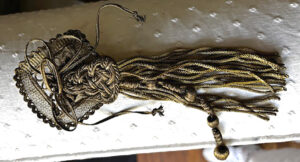
 EC inherited a Bible from her mom. It belonged to Isabel Robbins Carrillo (1845-1914), a lady from one of Santa Barbara’s most distinguished families. Along with the Bible she found two brooches. EC wondered if the brooches dated from the Californio period (1769-1846). Our area transitioned from the Spanish Period (1769-1821) to Mexican Rule (1821-1846). After the Mexican American War (1848) the Californio Ranchos fell in decline, as did the clothing styles of the Californios. The braided brooch is in a European style of the 1850-1860s and the “button” brooch is in a later style of 1880-1890s.
The Castillo family became known in the Californio period as cattle ranchers, and hide and tallow traders. Renowned for their horsemanship and hospitality, trademarks of the Californio way of life. The clothing of the period is also distinctive, a Spanish flair, reminiscent of folk styles of the 18th century. Conversely, the style of these brooches places them in the later part of the 19th century perhaps not within the traditional Californio era.
A European Flair
Matching the dates of her life to the style of the braided brooch, it’s possible the braided brooch belonged to Isabel Robbins Carrillo’s grandmother Maria Josefa Raymundo de Castro (1792-1853) or her mother Maria de la Encarnacion Carrillo (1814-1876). If either woman wore such a piece in the mid-19th century, she’d dress in the Continental style with a European flair. The brooch adding a slightly masculine, almost military flavor.
From the European Continent regimental uniforms came the braided metallic silk corded style of the braided brooch. That braiding also serves as a signature of both Spanish and French clothing. I estimate the brooch to date from 1850-1860. Women wore these at the collar of a shirtwaist, and the lightweight braid made them wearable on cotton fabric. The style in the last half of the 1800s trended to full skirts, tight bodices, small, belted waists. It included decorative features of braiding, ruffles, ribbons, with brooches worn at the collar.
By the last half of the 19th century, exotic Spanish styles and the romance of Spain as interpreted in clothing, and architecture, became fashionable. I studied the costumes of the famed Spanish dancer who made Spanish clothing a worldwide style. The courtesan and eventual mistress of King Ludwig I of Bavaria, the controversial Lola Montez, wore such a braided brooch circa 1850-60.
She Wore Braided Brooches
Lola chose Spain. She wasn’t born in Spain, nor Alta Californio, but in County Sligo, Connacht, Ireland in 1818 as Eliza Rosanna Gilbert. She made her debut as a Spanish dancer in 1843 in London, Paris, and Warsaw. Lola dressed in the Spanish style, and wore braided metal brooches to fasten a velvet cloak. Her stage presence was anything but the demur Californio matron. Lola performed in San Francisco in 1853. Her Spanish dancing career declined, along with her advancing age. She married a local newspaper reporter and retired to Grass Valley CA.
The tradition of braided metal broches, metallic mesh thread woven on a support of silk threading, dates to French and Spanish military (regimental) jackets of the 18th century. I found such an embellished braid in the collection of the MET Costume Institute, as a textile trim. The MET also owns an example in their collection of a metal tassel watch fob, made of 10K gold thread, which, like our example, is blackened with oxidation. By the late 19th century “tassel” brooches became popular made of gold, rolled or plated gold and lesser valued wirework in imitation of the metallic thread brooches worn in the previous years, by both women and men as a military flourish. When 10K or 14K gold tassel brooches added black enameling, these were worn as mourning brooches, especially as made popular in England after the death of Prince Albert (1861).
EC’s “button” brooch, more feminine and lacier, with a sentimental design of flowers, dates from the last years of 1900, a glass button with an reserve engraved and painted sweetheart design. The sweetness of the style places it later than the more structured metallic wire tassel brooch.
Is the tassel brooch a Californio brooch?
In that era finery was “imported” from the East Coast, so we cannot be sure it was made expressly for the Californio clothing style. Was it worn by a member of a noted Californio family? YES. Because of this fact, the value is in the category called irreplaceable