 Of all the many distasteful Presidents, I dislike Andrew Jackson for his bluff, rough man’s-man persona. After all, he slept in the dirt with his men in 1812 and earned the name “Old Hickory.” He loved snuff and chewing tobacco. The historic Jackson home, The Hermitage, features snuff boxes. For a collection of spittoons, however, I went to another distasteful family. The (Doris) Duke family provided the mother lode of spittoons, located at the Duke Homestead, a North Carolina historic site, featuring 387 of these notable spit repositories.
Yuck!
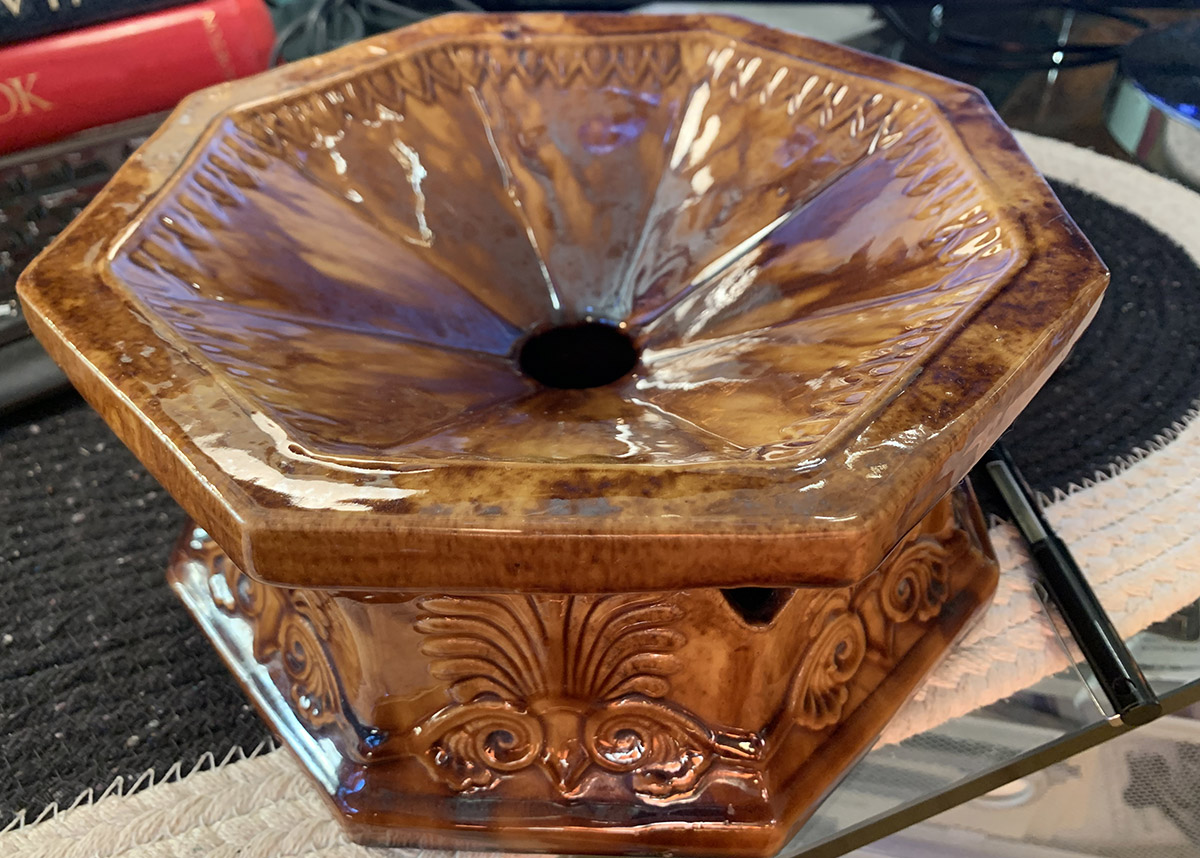
Thus we see JS’s Bennington pottery spittoon, in brown glaze, prettied up with rosette and arabesque reliefs around its octagonal sides. You see the hole and sliding ramp for the spit on the top, and the triangular hole to pour out the contents on the side. What poor soul emptied this in 1890? It measures four by eight and a quarter inches and weighs four pounds.
Spittoons, or cuspidors, are among the oldest forms made in porcelain. In the collection of the Zhejiang Museum, we find one dating from 286 CE. The most modern commercially manufactured spittoons appeared in the 1930s. Production ceased shortly thereafter because a new, more hygienic way of consuming tobacco became popular: cigarettes.
Pre cigarettes, a massive outcry came, mainly from women, against the habit that necessitated spittoons, prompted by public-health risks of spitting. Two epidemics hammered these concerns home. First came the 1918 flu pandemic, in which 50–100 million people worldwide fell stricken; 675,000 people died in the United States. Next came the tuberculosis epidemic.
Women gathered plenty of good reasons to protest men’s habit of spitting into these receptacles. And spittoons appeared everywhere: in saloons, banks, offices, hotels, and government buildings. If you didn’t provide a man with a spittoon, he spat on the floor or in the street, he reasoned.
In the late 19th century people fancied stoneware or brass, iron, and graniteware spittoons, considering them an advancement in public health and manners. That is, good manners provided he didn’t miss the small hole in the top. After all, one usually found the spittoon on the floor.
Spittoon A Necessity
Many a man chewed smokeless tobacco, commonly called plug or twist tobacco, popular throughout the 18th and 19th centuries. Tobacco manufactures pressed leaves with honey or molasses, dried in blocks that looked like modern candy bars, and sold as plugs. A man cut off a piece with a pocketknife and chewed away. Until the stimulation produced massive amounts of saliva, which one did not swallow without causing extreme nausea.
Tobacco manufacturers targeted various social levels of chewing men. At the top of the heap stood the most refined chewing tobacco, named after the famous champagne “Piper-Heidsieck,” a “luxury brand.” Masons preferred two brands to choose from: “On the Square” and “Master Mason;” the packaging came replete with Masonic imagery. In Ireland and England, a man chose from “War Horse,” “Condor,” or my favorite, “Mick McQuaid.”
At the bottom of the social ladder sat the five-cent chew called “Battle Ax.” That gave a man a jolt and a massive spit! Working men selected a classic sweet chew called “Day’s Work.” The Taylor Brothers aimed to corner the market with two brands: “Cannon Ball,” in the late 1800s, and, for the real man, “Bull of the Woods.” All these plugs came in specially designed, highly colored, themed lithographed tins.
Southern gentlemen preferred “Brown’s Mule.”
Men fond of dogs chose “Bloodhound.” I don’t know what kind of man went for “Climax” by Golden Twins. P. Lorillard Tobacco Company made most the most coveted tin called “Tiger,” which came in a faux-wicker box.
As far as the highly sweetened, flavored brands, the olden-day equivalent of today’s vaping, men chose an apple-flavored chew. And for the slightly offbeat, more avant-garde man, he bought “Little Breeches,” “Silk Finch,” or “Blue Grass.” Spittoons were named after brands.
Never to let a good tradition die, until the 1980s the House of Representatives contained a ceremonial “Speaker’s Spittoon” on the chamber floor. I wonder if the last Speaker of the House to take advantage of the spittoon was Tip O’Neill, Speaker from 1977–1987?
Because of the lack of rarity of the late 19th century spittoon, JS’s lovely memorial to the chew is worth $100.