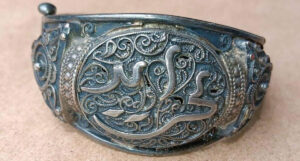
 Historian BG sent me a bracelet passed down from a friend of her grandmother’s whose husband served in North Africa during WWII. This bangle comes from Egypt. I know by its style of silver bands and ropes over filigree. BG’s provenance, the story of the piece, is likely correct, as the North African Campaign in Egypt became a vital theater for the British and Commonwealth forces in WWII. The soldier who brought this gift back likely came from the British Empire, and helped halt the Axis expansion toward the vital trade route of the Suez Canal.
The long and hard-fought desert war in November and October of 1942 led to a decisive Allied victory at El Alamein. Notable Lieutenant General Bernard Montgomery led the conflict against the German-Italian Axis Panzerarmee Afrika under Erwin Rommel. Winning this battle gave a major morale booster for the Allies and ended the threat to the Middle East. So the soldier who bought this for his loved one probably treasured this gift.
Souvenir jewelry like this illustrates a division between jewelry made for the tourist market, such as Vatican enamels, and jewelry actually worn by the women of the culture. In this case, this bangle serves as both. Muslim women are allowed to wear jewelry called “Dua.” For example, protective works in gold or silver bearing phrases from the Qur’anic verses in Arabic calligraphy. BG’s bracelet reads “Ya Mujeeb,” or “O Responder,” “O One Who Answers,” one of the 99 Beautiful Names of God, called the Asma al-Husna in the Islamic tradition. In essence, the bangle bears a sacred prayer: to be heard and to receive an answer.
“Real” Jewelry
Muslim customs allow women to wear both gold and silver, and this bangle is either .800 or .900 silver. This means it’s not of sterling quality but still contains a significant amount of silver. Islamic women are encouraged to wear “real” jewelry of modest means rather than costume jewelry. If a piece contains a sacred text, that piece is treated as a reminder of the one who holds power, not as an amulet with its own power to protect the wearer. When wearing Dua jewelry engraved with Qur’anic verses, it’s considered poor etiquette to wear such a piece into a restroom.
This piece dates from the 1930s to the late 1940s. I know by the unique tube-and-shaft pin closure, hand-wrought in the Middle East in the mid-20th century. The silver workmanship of wire filigree topped with silver bands, and the oxidation of the filigree in the depths of the bangle, point to a mid-20th-century date. I don’t believe this piece existed earlier than the 1940s. Egyptian Revivalism following Howard Carter‘s 1922 discovery of the tomb of Tutankhamun heavily influenced jewelry prior to that period.
The British archaeologist and Egyptologist discovered the intact tomb of the 18th Dynasty Pharaoh in the Valley of the Kings. Carter died at only 64, 17 years after he became the first person to enter the tomb 3,245 years after the young Pharaoh’s death. He didn’t succumb to the “Mummy’s Curse” although many suspected otherwise. With all the excitement around the opening of the tomb in the 1920s, “Pharoah Style” became the rage. BG’s bracelet has nothing to do with hieroglyphics, a fad that popularized across the globe after the discovery of Tutankhamun’s tomb. Jewelry made for a world fascinated by ancient Egypt and its exotic hieroglyphs.
A Beautiful Bangle Bracelet
Thus, I suspect a solider who fought in the battle of El Alamein in the early 1940s purchased this piece. Possibly from a local, an Egyptian woman who wore the piece and needed money, or an Egyptian jeweler. During that period, the majority of Egypt’s population consisted of Muslims who followed the Sunni tradition of Islam. Today, Egypt boasts more than a hundred-million majority Muslim people, making it one of the largest Muslim populations in the world.
With this wonderful background, redolent of a sacred phrase worked into a type of jewelry worn to protect the wearer, one might think the value higher than $350. However, we find many such pieces in the market with the same WWII provenance as BG’s bracelet. About 195,000 Allied forces served in Egypt, and 116,000 Axis forces. Soldiers bought back similar objects, and therefore this bangle, although beautiful, isn’t rare.