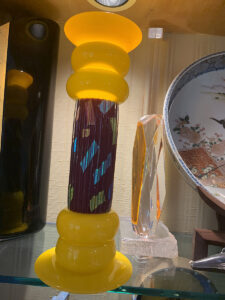
 Tacky? Bad Taste? Or a nice change from beige, black, and taupe? High or low culture? A serious work of art or a frightening mess from the 1980s? HG’s pseudo vase equals all the above. Not functional, just hilarious.
This Art Glass piece stands twenty inches high. Likely done by Ettore Sottsass, the founder of the Memphis Milano Group, Italian designers active from 1980–1987. If you lived through the eighties, you experienced this style, meant to face-slap tonal, overly tasteful, aesthetically pleasing design of the 1960s and 1970s.
Memphis Milano appeared anything but subtle and refined. Its characteristics include asymmetry, neon colors offset with pastels, geometric totem-like shapes, abrupt and jarring color blocking, an emphasis on random spheres, cones, and cylinders. The most un-classic of any piece of designed.
Why? An Italian taste shifting rebellion of course.
In 1980 in the living room of glass artist Sottsass, twenty-two hip Italian designers congregated to hate on Danish Modern, Eames, Gropius, and all the other aesthetes. They wanted to make rooms fun again. This meant a mix of Art Deco, Pop Art, and Op Art: surprising, loud, and based on plastic laminate.
The theme?
LESS IS BORE
—as opposed to the 1960s dictum, Less Is More.
In HG’s vase we see tasteless electric yellow, magenta, foil cobalt floating in the column. The work doesn’t hold water or flowers so its only purpose is to shock. This creative approach to an everyday, yet functional-less, object goes against the 1960s dictum Form Follows Function. Get it?
Other objects from Memphis Milano included lamps with bulbs on a half-moon-colored carriage that pulled across the room like a toy slinky dog; a chair with a round arch containing moon and sun shapes, impossible for comfortable seating; and the classic Carlton 303 bookcase with angled arms for wine storage and books, so redolent with trashy colors and mismatched patterns in the painted surface that none other than David Bowie owned one.
Karl Lagerfeld, another adherent of the style, used the aesthetic in his Monte Carlo summer house.
The American studio Ibex noticed the style as it expanded from Italy. You might wonder how the style got named Memphis after our US city. Two main places bear the name Memphis. One in Tennessee and one in Egypt, a fitting tribute to a design movement both lowbrow and highbrow at the same time.
At the main meeting of the twenty-two Italian designers in 1980, someone played Bob Dylan‘s “Stuck Inside of Mobile with the Memphis Blues Again,” and they, under Dylan’s influence all agreed to present a whole new look at a meeting three months in the future. A movement called POSTMODERNISM was born, although short-lived.
These designers hated Brutalism, the horrific facades of postwar concrete buildings, and machine-made objects, uniform in their style and shapes. But by 1987 the designers bickered, and the aesthetic faded.
Faded, until today.
Portuguese design house Homme stated that Memphis is back, indeed as a reaction to overly tasteful and restrained mid-century modernism, which they consider boring—so do I. Indeed, post-postmodernism is in the throes of a revival. They point to a 2005 show at LACMA of Ettore Sottsass’s work in glass and furniture; Christian Dior‘s Memphis-based clothing collection of 2011; the 2016 Supreme skateboard decks in Memphis designs; West Elm’s product line of Memphis fabrics; and the 2022 Triennale Milano show called 200 Objects 1981–1986, celebrating Memphis design. In fact, since this past May, the high-end design world rediscovered Sottsass’ work, with the top price paid at Phillips in New York reaching $385,388 for a brightly colored plastic laminate “school-type” lockers.
In the last three months the auction world has gone Sottsass-crazy in Europe. The German house Koller will auction his works soon, with estimates around $35,000 for a really good piece of tacky furniture. Also in play are the Italian house Piasa, the Japanese house Mainichi, the Chicago house Wright, Palm Springs’ Leonard Joel, Christie’s New York, Artcurial Paris, and even Britain’s Lyon & Turnbull.
So, game on, you mid-century modern purists. Memphis is bad taste, but I like it.
Yes, it’s clown furniture, but it’s coming back to challenge “good taste, 2026,” and for one, I applaud.
Less is indeed boring.