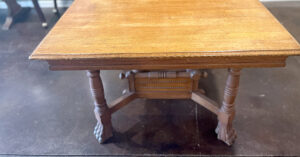
 MS sent me pictures of a table she felt compelled to buy because of its unique feet shaped like paws with toenails. Animalistic feet are the most common body part carved on furniture since the days of the Egyptian pyramids. For thousands of years the symbol of a bird’s talon adorned furniture. Likewise, lion’s and dragon’s feet adorned chairs, bureaus, tables.
To own a usable piece of furniture anchored by the image of the strongest animal in the food chain inspired confidence. Each culture of furniture-making humans used their own. The three-taloned Chinese dragon’s claw holds a ball, representing a pearl of wisdom. In the carved rosewood furniture of 19th-century China we see a beautiful sculptural blending of the claw around the ball. Thomas Chippendale capitalized on the adoption of the Chinese foot for English 18th century furniture.
The claw foot in England became crystal held by a bronze bird claw. In Japan, carved feet of bird’s claw anchored a piece in reference to the myth of the noble mother crane, who stands on one leg monitoring her nest. In the talons of her other raised leg, she holds a round stone. If she falls asleep, the noise of the stone dropping from her talons wakes her.
Chippendale Style
The best of this furniture is attributed to Thomas Chippendale in the mid-18th century England. The animal foot came to America a little later, as the colonies adopted new fashions slowly. Flourishing in America into the beginning of the 19th century and again in mass-produced oak furniture in the late 19th century American furniture-makers loved the claw foot or hairy paw. This is the style of MS’s table: a classical square American Golden Oak table top, with carved pillar and post legs, with a slightly Asian carved base, raised on four-toed lion’s paw feet. The Asian reference came from the Aesthetic Era’s fascination with the opening of the ports of Japan in the mid-19th century.
A magnificent surreal testimony to the Chippendale style is the three-story-high, thirty-eight feet, largest chest of drawers in the world, located in High Point, North Carolina, the gateway to American furniture. This one piece of furniture references the debt Americans paid to Thomas Chippendale’s 1754 book The Director. From this book America discovered the Chippendale foot, eagle’s talons, and lion’s paw feet.
North Carolina’s towering chest of drawers originated in 1926 as a huge bureau topped by a gigantic mirror on a stand. Built by the town fathers of High Point in a rebuttal to the 1922 world’s largest Duncan Phyfe chair in Thomasville, NC, and immortalized in 1955 as a monument on Main Street. Famous legs attached to famous posteriors have climbed the chair, such as Lyndon Johnson in 1960, posing on the ten foot square seat. They stenciled the mirror with “High Point, NC, The Industrial City: Bureau of Information.” Thus, the Big Bureau stood as a backdrop for all high school graduations group portraits for seventy years until the mirror rusted and the knobs fell off.
Big Bureau Redesigned
In 1996, a High Point craftsman redesigned the Big Bureau thinking his name might forever become linked to the greatest piece of furniture made. Sadly, he died in 2003 after completing the new chest of drawers in the style of Chippendale, painting it cherry red to mimic Chippendale’s favorite wood. He carved massive pairs of socks to hang out of a giant sized drawer in a nod to the town’s hosiery industry.
A real estate developer in 2004 bought the three story chest. He painted it battleship gray, and the socks in neon colors, as a tourist attraction. The town objected, but no one purchased the giant bureau until 2018. High Point University hired a local designer to bring it back to Chippendale style and color, and to repaint the socks in a more respectable palette.
This serves as the largest example of a period piece with Chippendale feet in the world, delicate cabriole feet that harken back to the paw design. MS’s table is a much later, and smaller, version of the style, manufactured in the center in the late 19th century for Golden Oak furniture, Grand Rapids.
If MS’s table were thirty-eight feet tall, it’d be worth many tourist dollars as the largest 19th-century table with lion’s paw feet. That’d make the table’s toenails twenty inches long. Note, however; lions don’t have toenails, they have retractable claws. The value of MS’s table, as is, is $500.