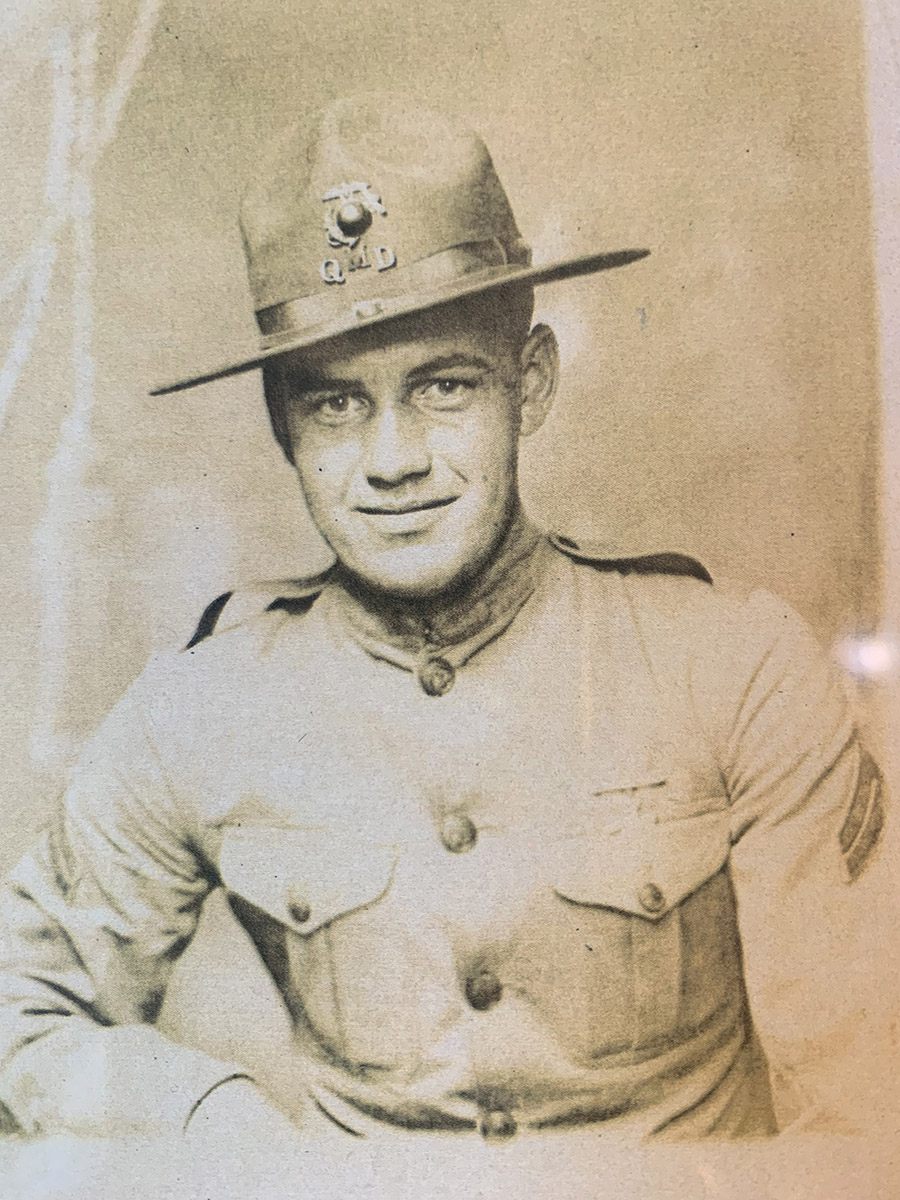
 JJ asked me to tell her about this picture of her great-grandfather, in some branch of the service during WWI. Family lore says he was good with machinery, and a motorcycle cop in St. Louis. That city transitioned from horse patrols to motorcycle cops for Forest Park in the late 1920s. He also serviced his own Model T and his motorcycle for the force.
She believes they stationed him in France, and he made it back to a barracks in the US in 1921. A letter dated 9/16/21 to his sweetheart on St Vincent Street in Saint Louis, postmarked Navy Yard Station, Philadelphia, mentions both their family homes on that street. In this letter the man in the photograph mentions that he blew his whistle as vehicles came into the Philadelphia barracks, and he served on a funeral firing squad. No, he didn’t execute anyone: his rifle saluted a fallen soldier at a funeral close to Valley Forge. He mentioned a nice birthday.
With this information I found a gravesite at Jefferson Barracks National Cemetery for this soldier born August 28, 1901. The VA records page located his burial plot there.
What I Learned From His Uniform
His uniform style and weight of fabric indicates he enlisted near the end of WWI or immediately postwar. He stayed in the Marine Corps until after 1921, based on the letter dated fall of that year from Philadelphia barracks. He reached, by the time of this staged portrait, the rank of Corporal. The insignia on his hat indicates he served in the Quartermaster unit, 1918–1921. I borne the out with a dip into the USMC Muster Rolls. I’ve submitted a full request based on the Freedom of Information Act for this soldier’s full Muster Roll.
He wears an enlisted service uniform, Pattern 1912, dressed here in a summer service tunic of khaki worn from 1912–1920. He sports a high standing collar, shoulder straps, dark bronze eagle, globe, and anchor buttons, plus two upper patch pockets with pointed flaps. The two chevrons on his sleeve indicate his rank of Corporal. On his left breast he wears a ribbon bar. An image search and close-up, even though the photo is sepia, indicates this bar is likely a Marine Corps Good Conduct Medal in deep crimson and dark blue, given to enlisted men who served honorably from April 1917–November 1918. He might also wear a WWI Victory bar awarded in 1919 for active duty.
Remember he worked as a mechanic when he returned from the war and joined the Police Force. In the Quartermaster Department in Philadelphia, he likely worked in transportation maintenance on both horse-drawn vehicles and motor transport. The Philadelphia barracks was a center for the Corps’ supplies, clothing, and logistics. That headgear, called a 1912 Montana Peak campaign hat, indicates his place in this division. In this letter he instructs his sweetheart, getting quite technical, on how to shift a Ford, which he says is easy to drive even for a simpleton like himself!
Although we don’t see his trousers, since he wore a summer tunic for this posed portrait, it’s likely he wore straight-leg pants, not breeches. Straight pants came high-waisted, with a button fly, side pockets, and a cinch strap at the back waist.
If he wore a winter tunic, trousers came in heavy forest-green wool, a color called “Melton,” unique to the Marines. The footwear, as this is a garrison shot, would’ve been ankle boots in russet-brown leather.
Surprisingly young, in his early twenties, he wrote a letter describing some of his duties to his sweetheart. Most interestingly is a short and sweet little love declaration read by his lover only after she peeled off the stamp. I see another sweet touch in a tiny inscription buried under the flap of the letter saying, “Love XXX ‘e.’”
I learned that because these letters were censored, this Marine had to be resourceful. I’ll let JJ know the results of my request to National Personnel in St. Louis!