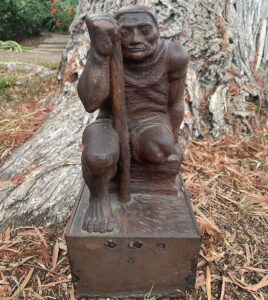
 JS sent me a chunky, hand-carved wooden sculpture of a powerfully built male figure with an amputated left leg below the knee. He’s shown in a direct, full-frontal pose, seated on a plinth and supporting his head, upper body, and posture with a heavy staff. His muscular body, face, and skull are almost simian. His hands and remaining foot are masterfully carved, yet disproportionately massive for the size of his body. The figure is boldly “chipped” from a solid block of hard, dark wood in an effort to imitate the marks of a cooper’s hand hammer. Turning the piece around, the carving of his back reveals a knobby misalignment of the spine, perhaps suggesting scoliosis or a pronounced hunchback. The work portrays a simple peasant in spirit and costume. He wears a simple smock and short breeches.
This figure begs a broader question: how is mobility impairment portrayed throughout art history? Curiously, I find no precedent for this exact figure in imager. I do find ancient gods, fairy-tale characters, and figures from the Brothers Grimm portrayed with staffs, limps, or disfigured legs and feet.
Questions Arise
What era did the artist mean to evoke? If they intended it as a medieval peasant, portraying nobility in the face of adversity, why the defining characteristic of an amputated leg?
This work of art “found” me as I face a fifth hip replacement and haven’t walked without a cane for over a year. It made me wonder what did people do before titanium joints and modern prosthetic surgery? More importantly, what does the image of an impaired body mean throughout history?
Staffs, sticks, canes, crutches, corrective devices, and artificial limbs have played a part of daily life since Classical antiquity. In that world they saw them not as symbols of weakness but as emblems of empowerment. A staff, for example, is a universal symbol of power, survival, stability, and wisdom. It may signify either authority or humility. Likewise, the image of a missing limb or physical deformity often became the defining characteristic of an individual who overcame loss and survived adversity.
Early Greek red and black figure pottery depicted warriors and elderly scholars using T-, L-, or J-shaped walking staffs with crossbars. Archaeological burials occasionally preserve examples made of gold, silver, or ivory. Perhaps the best-known figure is the lame god of the forge, Hephaestus, who fashioned Achilles’ armor and created what we might today call assistive technology: animated servants, mechanical devices, winged chariots, and other inventions that rose above physical limitation. Like JS’s sculpture these portrayed impairments not as weakness but as sources of creativity, ingenuity, and strength.
“Staff” Through the Ages
Two fascinating expressions may even derive from such portrayals. The caretakers of an impaired nobleman became known collectively as his “staff,” a term we still use today. Another apocryphal legend tells that after a Greek named Dorian had his cumbersome prosthetic footwear stolen, he cursed the thief with the words, “If the shoe fits, wear it!”
I wondered whether the sitter for this sculpture might himself have access to a false limb, assuming he portrays a figure from a distant time and place. Archaeology suggests that possibility. A famous Roman prosthetic leg, now in the Wellcome Collection, consisted of a wooden core covered with bronze sheeting secured by bronze fittings with leather straps. It enabled its owner to walk with the aid of a staff. Other burials dating from the second through sixth centuries revealed skeletal wear consistent with long-term use of artificial limbs, corrective footwear, or crutches. Anthropologists recovered bronze replacement toes from ancient graves. In the seventh century they found the remains of a Frankish soldier buried in Germany with a wooden and bronze below-the-knee prosthesis. JS’s sculpture, therefore, may not represent medieval fantasy as much as medieval reality.
The remarkable strength of this sculpture lies not only in the massive body of its subject but in the staff he rests on, both physically and metaphorically. Like the staff of a king, it becomes a symbol of endurance. I searched for an artist working in this style to no avail. I believe the piece dates from the early twentieth century, reflecting the powerful directness associated with early twentieth-century German Expressionism. The sculpture possesses a compelling dignity that reaches far beyond its modest scale. Not a bad find from the Boys & Girls Club Thrift Store in Ventura!