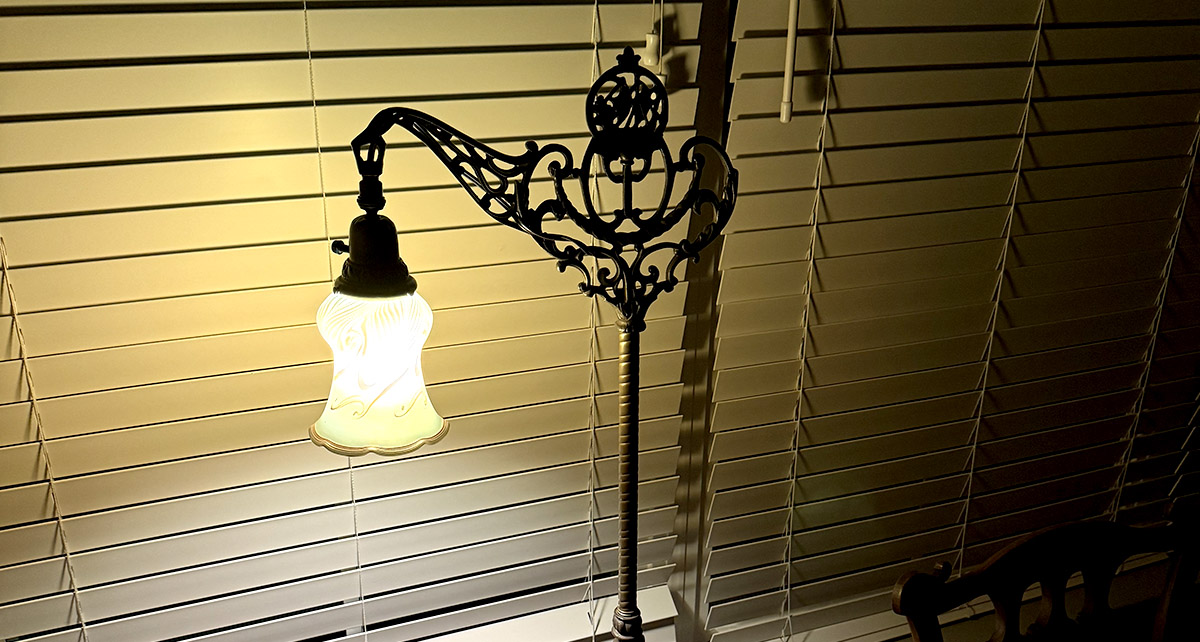
 Along the Art Nouveau lines of the 1970s, DD sent me a floor lamp with a 1979 Tiffany-style blown-glass shade in the Quezal tradition. The attached shade hangs on a standard floor-lamp fixture with a curving, arched reading-lamp-style brass support. The shade features a feather design, the signature vocabulary of many 1970s blown-glass artists.
How we dressed in the 1970s, in many ways, became a restatement of the Art Nouveau fashions of the early 1900s. My old Deerfield High friends from the 1970s sent me photographs of “our gang” with flowing hair, psychedelic shirts, bell bottoms. The reinvigoration of 1900 Art Nouveau became a predominant style after the countercultural revolution of the 1960s. We wore romantic, long, simple prairie dresses, Edwardian shirtwaists, oversized collars and belts, and cameo costume jewelry to match.
The acid-etched signature on the shade reads Vandermark, for Jerry Vandermark, dated 1979. Vandermark became known for his perfume bottles and vases, many of which we still find as “vintage” objects. And this creates a question that continues to confuse people: Which Art Nouveau is it—1900 or 1970?
In 1972, Jerry Vandermark joined with glassblower Doug Merritt to make museum-quality Art Nouveau and Art Deco glass in the styles of Tiffany and Steuben, as well as cameo glass in the style of Gallé. I receive hundreds of emails from people asking whether they have a “real” Tiffany or Gallé shade. The 1970s artists excelled at reproducing the vocabulary of earlier blown glass.
But why did we all gravitate toward Art Nouveau in the 1970s? And why did music-poster designers love the psychedelic line of former Nouveau artists such as Alphonse Mucha?
Pendulum of Art History
Perhaps the answer lies in the pendulum of art history, which seems to fluctuate between the geometric line and the organic line. Today we stay firmly in the geometric stage: mid-century modern, clean lines, few curves, and little decorative embellishment. In the 1970s, we returned to the C-curve and S-curve, to sinuous organic tendrils and the suggestion of natural growth.
Even typography participated. The vocabulary of Art Nouveau appeared on the covers of fantasy books. Somehow the organic lines of vines and tree canopies, combined with the romanticism of the nonlinear and the non-logical, perfect for fantasy illustration. The American second edition of The Lord of the Rings, published in 1966, helped establish a romantic, mock-Art-Nouveau visual vocabulary that remained a hallmark of fantasy escapism ever since.
Two particularly influential exhibitions helped bring Art Nouveau back into public consciousness. In 1966 Aubrey Beardsley exhibited at the Victoria and Albert Museum, and the Museum of Modern Art’s 1970 exhibition of the work of Art Nouveau architect and designer Hector Guimard. These exhibitions helped spearhead the cultural revival of Art Nouveau.
And then came the psychedelic poster.
The great rock posters of the late 1960s and early 1970s “stole” the sinuous line from Alphonse Mucha and the other Art Nouveau artists, transforming it into something new. Mucha’s elegant women, flowing hair, ornamental borders, botanical forms, and curling typography became the visual language of a counterculture that searched for something organic, romantic, sensual—and decidedly different from the rigid geometry of modernism.
So when I look at DD’s 1979 Vandermark lamp, I don’t see a copy of 1900.
I see 1970s Art Nouveau looking backward.
And perhaps that makes the lamp so quintessentially of its time. Design and decorative art history rarely moves in a straight line. It’s a pendulum swing, not always equally balanced, between the organic and the geometric. Similar changes from straight to sinuous in well-known design periods may help explain this push and pull between form and line, and then back to line and form again:
- The sinuous, graceful cabriole legs of Louis XV gave way to the geometric lines of Louis XVI, with straight-backed chairs, straight legs, and geometric inlay.
- Art Nouveau morphed into Art Deco, with its streamlined modernism.
- The geometric modernism of the 1960s swayed into the Art Nouveau revival of the 1970s.
- The severe, straight, black-lacquer furniture of the 1980s, and the geometric colors of Memphis, eventually gave way to the natural neutrals of the 2000s.
All trends get dressed up again in new clothes and come back to haunt us.