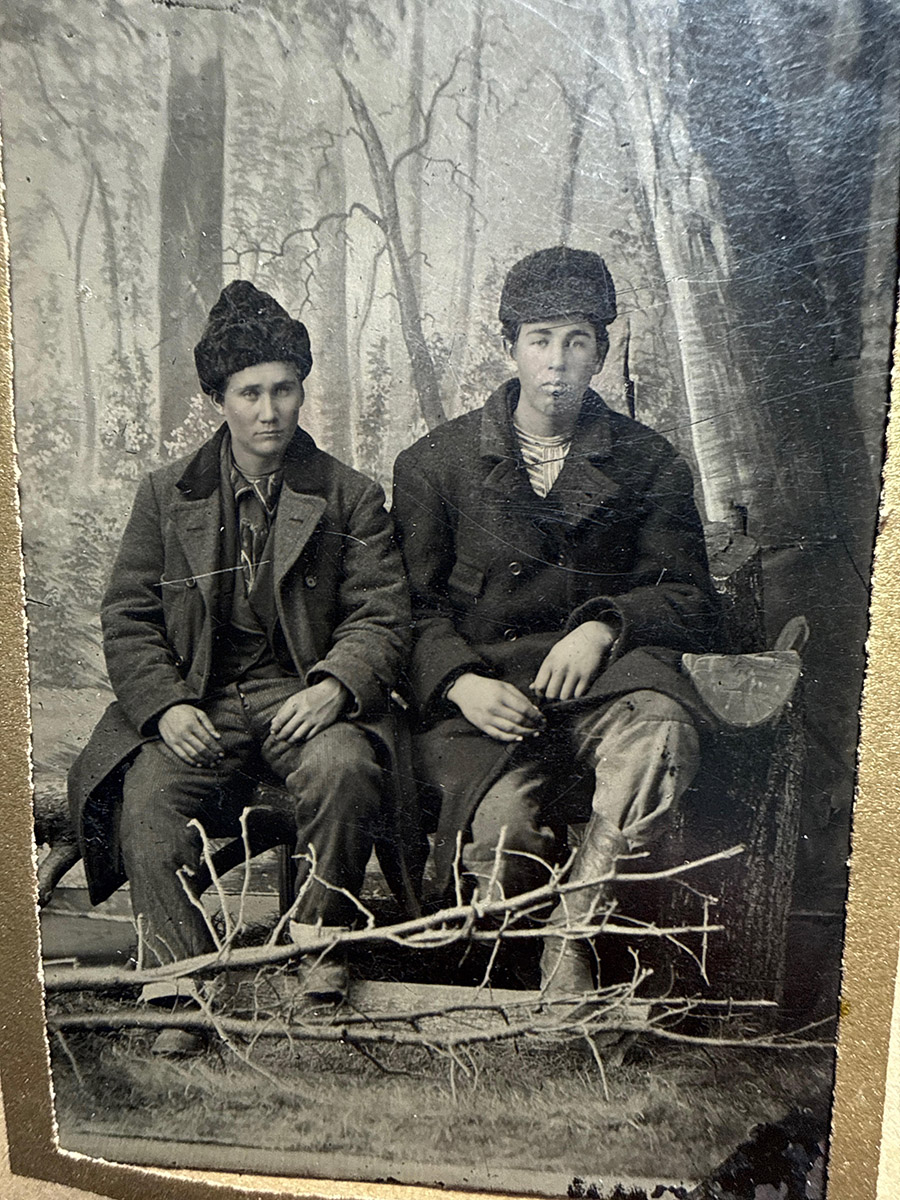
 KK sent me a fantastic 1880s silver gelatin photograph of two young men. They’re friends or brothers, we do not know. They’re dressed in oversized fur flap-eared caps and long winter coats. The painted, scene-set backdrop shows the impressionistic image of the deep Northern woods. The “brothers” wear wool trousers tucked neatly in their high work boots. One brother arranges his forearm on his thigh in a burly masculine gesture. Adding to the theatricality of the painted backdrop, they sit on what resembles a giant log. Straightforward, they gaze seriously into a massive wooden studio camera. The scene set, flash powder over the photographer’s head ignites a dangerous mixture of fine magnesium and potassium chlorate that widens the young men’s eyes.
But the mise-en-scène, the vision of two lumberjacks interrupted from manly labors to sit on a log, shows false notes. One man’s long tailored coat of dark worsted wool bears a classic velvet collar, likely once worn on Park Avenue, not in Saskatchewan’s cold forests. The photo is a performance, not a statement of two young men and their rugged occupation, the genesis of the cultural portrayal of the “created” self-image. In social media, as in life, we inherited the invention of self- hood. In this old photo, the myth of masculinity takes center stage.
Backdrops Represent
Decorative backdrops in the late 19th century for photographic studios “scenics” custom painted in a host of subjects: a palace interior, a library, Niagara Falls, a Barbizon School French landscape, balustrades and receding columns with curtains, a shadowy Rembrandt-style dark vista, the Back Woods, a floral bower. We do the same psychological trick with our selfies and our backgrounds on Zoom calls. Our chosen backdrop is a projection of an image, perhaps not an authentic location, but an authentic affect. The “lumberjack brothers” are early representatives of the characters we play with our clothing, our “backdrops,” our constructed representations.
The 19th century Saskatchewan he-man image is performative and relies on the viewer to “buy” the cultural reference. A disconnect, velvet collar and all. Look at their clothing: not a stain. See their delicate hands. One “brother” displays delicate Tartar style cheekbones and the diminutive stature. The irony portrayed is the disconnect between the subject, the background and props, how this difference reflects on the “characters” of the young men and the “lumberjack” persona they occupy.
The photographer doesn’t aim for realism or accuracy but wants to “sell” a theatrical portrait to suit the masculine ideals. The boys wanted their money’s worth for immortality.
Cultural Context
Arising in the 19th century, is the myth of the lumberjack: a song rings in our ears: “I’m a lumberjack and I’m OK,” a joke that works because by the time Monty Python wrote it, transgressive hyper-masculinity was spoofable. This photo is where it starts.
Even in the late 19th century there was a disconnect in the myth of the lumberjack between idealization and reality. First, a backwoods Northern lumberjack wasn’t a respectable figure of late Victorian society: these men lived in rough camps, drank, womanized, drank more, fought, and, as the song says, they didn’t care. He acted a man, not a city-domesticated, shackled by wife; the antithesis. That’s why the “brothers” play lumberjack, with hypothetical the strength and fortitude for cold and brutal conditions. Phallic? Lumberjacks topple monster trees and stand victorious over the trunks, one leg raised on the carcass. The Paul Bunyan/Babe myth contrasts with the “Gentleman Jack;” 19th century Stories about the heroic enterprise of forestry portray the “last” vestiges of masculinity in the wild forest of the North Woods.
In a studio never below 60 degrees, the photographer and the “brothers” create the vision of the strong North Woodsman: cold, hardy, isolated, needing no female or friend, other than his fellow lumberjacks, self-reliant, a symbol of National identity in a play-act.
Today’s performative backgrounds of social media and Zoom calls are the grandchildren of this photo. Moreover, the cultural baggage of the myth of 19th century masculinity is here in the image of the 1880s lumberjack. Think: “I’m a lumberjack and I’m OK!”
Footnote:
In Arkansas, during the long summers I dreaded at the Lake of the Ozarks in the 1970s, I remember a restaurant my father loved. In the heat and humidity we were shocked to see a giant fiberglass Paul Bunyan in a rolled up flannel shirt with his blue ox, Babe. Once inside, we ate all the flapjacks we wanted, “lumberjack” style.