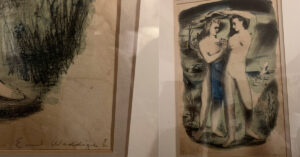
 Young family guy RT wrote that he likes 1940s lithograph prints in a realist style. He picked up online two nudes by Emil Weddige (1907-2001). RT wants to know about the fraction 5/30 next to Weddige’s name, and if he purchased for a fair price of $500.
The piece is large at thirty-two by twenty-eight inches on yellowed paper. It’s a colored lithograph created in 1945. The theme is horror of WWII and peace found in simple things—the sound of the sea.
My younger clients now buy vintage original prints in silkscreens, lithography, etchings and engravings, woodcuts, and serigraphs. This became a worldwide trend. Today the print market, not reproduction but original prints, represents almost one third of all auction purchases, mainly by younger buyers. They covet the idea of a big name artist on their wall, whom they CAN afford from a reputable auction house or dealer.
To Make a Wise Purchase, RT, You Need to Know:
- The medium. What is a print? Various print mediums allow the artist to make more than one image of the same work, again and again. In either an “open edition” with no limit to the number of images made, or a “limited edition.” That’s what the fraction on RT’s print means. His is number three of a “PULL” of thirty images from the same lithographic stone. Limited editions are expressed as a fraction in the margin, the blank space under the print itself, usually around the artist’s graphite signature, if signed, or on the opposite side bottom. Often in older prints this is covered by the matting. In vintage Asian woodcut prints you will NOT see this done.
- RT researched to make a wise buy. Because RT’s print is an original, it’s unique. However, it’s part of a series of thirty JUST LIKE IT. But possibly NOT alike in conditions or hand coloring. If his print has brothers and sisters, find prices paid on my favorite sites: ArtNet, Ask Art, ArtPrice, and Mutual Art. RT must know the name of the artist to access data, as these databases don’t use Google Image search but listings of prices PAID.
RT asks: What is the trend?
Will I find more 1940s post war prints? For SURE! The print market currently flourishes for all artists, first tier especially, and post war and contemporary artists more so. Like everything else in the art world, prices are driven by artist’s FAME and NAME. Once an artist’s work on canvas, always considered of more value than their prints, sells for millions, the print market for that artist jumps.
Take Ai Weiwei for example. He uses his print studio as a sales arena for his international projects. Keeping his editions HIGH, he makes over a thousand of the same image, the cost stays low. A young collector might own a piece for $2,600. Warhol’s highest price went FOR a print, a screenprint of Marilyn selling for almost $200,000,000. So today RT might buy a Warhol print but he will pay for the name. I suggest he look into other strategic “buys,” modern/post war artists such as Diebenkorn, Man Ray, and land art prints such as those by Christo.
Bargains exist today, but competition does too. Print market sales increased almost fifty percent since 2021. Buying online is relatively safe since prints have a verifiable publisher, in a numbered edition, and are standardized. Young collections without the means to buy a Lichtenstein or Haring might do what RT plans to do. He’ll specialize in an ERA and STYLE underrated,1940s realist prints.
Search for prints signed twice, once in the “plate” in the image itself, and usually in pen or graphite. Look for a fraction, a LOW fraction, and better yet the initials AP, which means a work printed for the artist’s personal collection. Often more than ONE AP in a series.
The value of the work by Emil Weddige (1907-2001) is $500. However he was posthumously featured in a recent show at the Flint Institute of Arts Rust Belt Artists, listed as Ann Arbor’s pre -eminent lithographer. An ad in the Ann Arbor News 1945, around the date of RT’s image, blatantly says: ”A Possible Christmas Gift: Lithographs by Emil Weddige, $5 to $25, telephone 2-4956.”