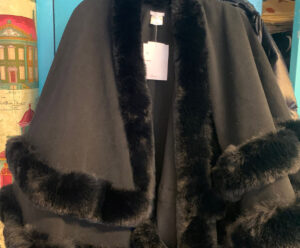
 CS sent me a vintage cape with rabbit trimmed fur on cashmere. She wonders if with the tiny moth holes mean that it’s NOT worth the price tag of $120. Does the historical value trump rarity value? The answer is NO. Late 19th century capes don’t fall in the rare category!
Capes became part of history as protection from bad weather. They signified status, style, rank, and by virtue of shape in fabric they covered anything from Batman’s shoulders to Jackie Kennedy’s inaugural white silk cape.=:
A Few Cape Names and What They Mean
- Roman toga: a square piece of fabric fastened at the neck, signifying rank and status, often called a pallium
- Greek chlamys, fastened at the shoulder
- Aztec tilmatli, worn as a sign of status by emperors, priests, warriors
- Medieval chaperon, worn for warmth and ease of movement with a sword underneath
- Renaissance Spanish cape, short and adapted by all well-born Europeans in the 15th century, often trimmed in fur. Because of cold homes, these were designed for wearing both inside and outside the house
- Victorian Opera Clock, worn loosely so as not to crush a gown
- A fashionable wrap called the 1930s Cocoon worn by fashionable women
- The 1938 adoption of the US Marines Cloak
A few terms for cape signify power, invoke royalty, indicate religious fervor or chaste modesty, and contain power all in one garment. For an example, King Charles of Great Britian wore three different capes for his coronation. So did other members of the Royal Family, including the children.
BIG News in the Fashion World
Fashion magazines like British Town and Country covered high fashion capes in the 1920s and 1930s. The cape CS sent me arrived earlier in fashion history, circa 1890. Greats such as Jeanne Lanvin designed capes to go over an evening gown. He called it “Moonlighting,” a marvelous piece with beading on rich fabric. Slightly later in the 1930s Elsie de Wolfe commissioned Elsa Schiaparelli to design a cape made to echo the colors of her garden interpreted in beading.
In 1950-60 the American-born beautiful Consuelo Crespi wore a magnificent cape to Truman Capote’s Black and White Ball. I already mentioned Jackie Kennedy’s white silk floor length and voluminous cape she worn to her husband’s Presidential inaugural ball. All these capes became BIG news in the fashion world.
1930s pattern maker McCall Bazar made patterns modeled after Lanvin and Schiaparelli that anyone could sew. A cape wasn’t complex to make, and oh so elegant. French cape styles became accessible to anyone.
Over the years, capes took different names referring to the different lengths and uses of the garments. A capelet is a short cover, barely reaching past shoulders. A mantelet is a scarf-like covering popular for years, 1730-to the 19th century, a scarf neck covering. The paletot comes with many collars and is worn to protect against rain. The pelerine is a short, shaped shoulder cape. A palatine is a silk cape worn over a negligee.
Since the Greek Times Capes Reflected Social Standing
Think of the Red Cardinal’s capes witnessed in the choice of the Pope, and the evocative procession of the Cardinals through the Sistine Chapel. No one forgets the power of the cape in that setting.
When trimmed in fur, such as sable or mink, the cape became a form of status, and trimmed in rabbit or fox, a lower status. Color matters: scarlet for Popes, black for Judges, white for virgins, blue for modesty.
The main market driver for vintage capes is the KIND of fur used to trim. What was once popular, and plentiful, in the late 19th century is abhorrent today. Monkey fur trimmed capelets with pelts of Abyssinian or Colobus monkey fur of Central America you won’t be able to sell. In fact in some cases they are banned to trade. However the 20th century capes by the great designers are of huge value. I suggest looking for the labels, and steering away from fur.
My answer to AA’s question? Is the cashmere cape trimmed with rabbit dating from the 1890s worth $120? Not with moth holes! No.