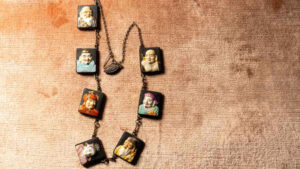
 JE owns a wonderful 1900s vintage Japanese necklace composed of faces of benevolent gods. The links are porcelain on sterling.
The faces, and the gods they belong to, are important to Japanese mythology, the Seven Gods of Fortune. We see them pictured on kimono toggles called netsuke, and in woodcuts since the 1600s. Although this necklace pictures them individually, they’re often grouped together on a ship at sea, a lovely ship of treasures. Tradition calls those treasures: longevity, prosperity, popularity, integrity, dignity, kindness and magnanimity. The gods that personify each virtue bestow these blessings. Although the Seven Lucky Gods are immortal, the Buddhist priest of the powerful Shogun Mikawa “discovered” the gifts they bestow on good people in the 1500s. The Seven Gods, called the ‘Shichifukujin’ have been recognized in art—and it seems, in dreams, for over 500 years. Let’s meet the Gods and what they embody. Then we’ll meet them in dreams.
In order of the necklace, the Seven Gods:
- Ebisu, a god of Japanese origin, who reigns over fishermen, farmers, and merchants, and stands for integrity. We see Ebisu pictured on Sapporo Beer cans! Ebisu is celebrated at his shrine in Osaka each year in a race in which the fastest runners compete. Those who win are the “lucky men” blessed with a year of good fortune.
- Daikokuten is the god of wealth, prosperity and agriculture, akin to the Hindu Shiva, who destroys and creates.
- Benzalten is goddess of kindness, the only female, and rules over wisdom and music.
- Bishamonten is dignity, a warrior god.
- Fukurokuju is popularity and good luck for and with children.
- Jurojin is longevity, pictured with a deer, he cures illnesses.
- Hotei is magnanimity, and he carries a sack to give to the poor. He grants wishes.
The Toshikane Company made this necklace in the first or second quarter of the 20th century in the rich porcelain making area of Arita. Chief designer Minami designed sculptural objects prior to World War II.
After the war, Japanese companies resumed private export trade in 1947. Thus, these necklaces and buttons made with faces of the gods sold as souvenirs through military bases in Japan and Guam to western servicemen. Surprisingly, the Toshikane Company continued to make “Gods of Fortune” buttons, in the style of Japanese Noh Masks, until 1975. The necklace bears a stamp “made in occupied Japan” The Seven Gods necklace is circa 1940s, happy porcelain faces set upon silver, linked with a silver chain.
Prized Jewelry and Lucky Dreams
These masks on jewelry are prized, as the gods are powerful and immortal. People have celebrated them for centuries in Edo (now Tokyo). Pilgrims visit the shrines of each of the lucky gods there in the new year. Wear this necklace to undertake the walking “Yahaka” pilgrimage to each of the seven shrines. If you cannot visit the seven shrines, the traditional practice is to invite these gods into your home. Do this as a custom. Sketch each god in their pleasure ship on paper, and on New Year’s Eve, place that sketch under your pillow. This encourages the lucky “first dream” of the New Year.
The tradition of “hatsuyume” (first dream) indicates the vision you see as you doze at the start of the year will predict the next twelve months. Hatsuyme originated in the 1660s with the first Edo shogun. One of Japan’s most powerful rulers, he lived in the shadow of Mt Fuji, Japan’s tallest mountain, and kept the fastest hawks for his hunt, and the earliest seasonal purple eggplants to eat.
Every New Year, hawkers in the streets sell sketches of the Seven Lucky Gods in their ship. This is because not everyone can draw, and putting such a work of art, called a ‘takarabune’ picture under your pillow increases the chances of a great dream of
- Mount Fuji
- Hawks
- Eggplants
The Seven Gods increase the chance you’ll dream of these three, and if you want added protection, ask for a sketch of the Kanji Monster who eats bad dreams.
The value of the lucky gods necklace is $500. But if JE owns a set with hair ornaments and earrings and a bracelet, the value is $1,000.