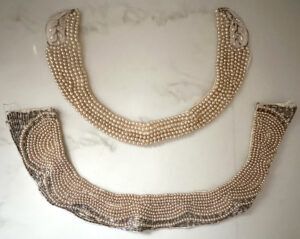
 JC sent me her mom’s pair of pearl collars, faux pearls on silk that graced a common cardigan or blouse in the 1940s. Glentex produced these in Japan, and in Brooklyn, with the curious name of Barr and Beards Inc.
I remember my grandmother owned a few of these. As a kid I played Queen Elizabeth wearing a collar of pearls. Oma called them her Dickey collars, about fourteen inches long and one to two inches wide.
Why these middle-class version of fine pearls became fashionable Involves the history of salt and fresh water pearls. By the late 1880s few women afforded a “real” pearl collar. Pearls from the great natural beds in the Arabian Gulf became over-fished. Designers sourced saltwater pearls from Australia, the Philippines, and Indonesia. Americans hungered for pearls so much that those bivalve mussels that produce freshwater pearls, once plentiful were no longer available. Farming those freshwater pearls in the late 19th early 20th century decimated the Mississippi mussel!
History of Wearing Pearls Ebbs and Flows
The depletion of vast pearl beds throughout the past thousand years effected this fashion. In the 15th and 16th century agents of European nobility farmed the natural pearl beds of Central and South America. They passed laws to keep common folk from wearing pearls. Only royalty, like Queen Elizabeth, draped themselves with pearls in the 15 and 16th century. Royalty always loved their pearl prerogative: Julius Caeser loved pearls, and banned non-worthy people from wearing them in Rome.
European royalty weren’t alone in wearing pearls. The Hindu culture considered them dear, calling them the “daughters of the Moon” in the Vedas. Pearls always conger a connected with the oceans, and of course Venus.
1940s cultured pearls still seemed a relative rarity, and although few people afforded natural saltwater pearls, cultured pearls became more affordable. Still, a faux pearl collar came much cheaper. So JC’s mom did the next best thing with a shop-girl’s budget. She bought a faux pearl collar, which in 1943 cost $1.
Affordability of Pearls Changed
Entrepreneur Kokichi Mikimoto invented cultured pearls in 1893. He realized that if he put an irritant inside a specific kind of oyster, he ”grew” a pearl in special hanging beds off the coast of Japan. By 1920 cultured pearls became affordable—and almost perfectly round and white, contrasted with natural saltwater pearls, hunted by those interpreted deep ocean divers.
Mikimoto found the almost perfect specimen of cultured pearls, the Akoya—limited to certain oysters, as few oysters “grow” a pearl.
I recently returned from an appraisal of a collection of a wealthy client who own a home in Puerto Vallarta. This started me on a kick of re-watching Elizabeth Taylor movies. Taylor lived with Richard Burton at the time of the filming of John Houston’s Night of the Iguana. My client’s housekeeper, who isn’t young, remembers Elizabeth Taylor’s house in Puerto Vallarta, received as a gift from Richard Burton in 1964, now the luxurious hotel Casa Kimberly in the city’s historic downtown area. The property was once a love nest for her and Burton, connecting their huge “casitas” by the famous “Bridge of Love.” Burton built that bridge of love, their private getaway during the filming, to avoid paparazzi.
The connection with pearls is part of this story:
Burton bought the world’s most famous pearl, La Peregrina, at a Sotheby’s auction for $37,000 in 1969 for Taylor, as a Valentine’s Day/37th Birthday gift. One of the most memorable of all the world’s pearls, La Peregrina is the largest pear shaped pearl at 55.95 carats, (4 ounces), the weight of a deck of cards. Taylor’s estate owned it till it sold in 2011 for $11 million.
As a contrast, the value of JC’s mom’s faux pearl collar today is $10!