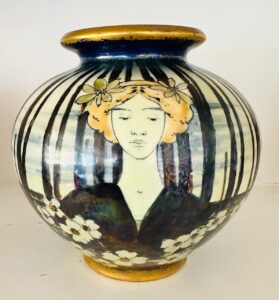
 This winter I bought a vacant for years 1919 chalet on Lake Arrowhead. I’m studying its architecture and decorative art of the period. Coincidence? Synergy? Everything I look at trickles back to this period, like DD’s vase from the first quarter of the 20th century. This thirty-year period in the history of design is so fruitful. Styles butt heads and blend in some cases, thus DD’s vase is a blend of:
- Arts and Crafts Art Pottery
- Viennese Secessionist design
- German Jugendstil
- Exoticism, nature, sexual motifs
- Art Nouveau
- Mission Craftsman designs in the US
Under the broader umbrella of Art Pottery, this era focused on freedom of flowing line, unique colored glazes, naturalistic form, unique scale and sizes, animals, the female form, marine life, and flora.
“Allegory” Vases
An area near Dresden abundant with Kaolin-rich soil, the Turn Teplitz region, saw porcelain production and innovative designs in the late 19th early 20th century. One maker of DD’s vase, Alfred Stellmacher, developed an unique composition for his “slip,” Ivory Porcelain, resistant to high temperatures. The label on DD’s vase says: “Turn Teplitz Bohemia, R st. K Made in Austria.” Riessner, Stellmacher, Kessel, a partnership in Teplitz called its wares “Amphora.” The company became known for “allegory” vases that referenced a story. In this case a Faustian image of Gretchen, the maiden, despoiled by Faust.
Each of the three founding partners, Riessner, Stellmacher, Kessel brought a different approach to the pottery business. Their distinctive porcelain won them a Gold medal at the Chicago World’s Fair in 1893. Stellmacher broke from the firm in 1905 and formed his own company in the Kaolin-rich region teeming with other porcelain factories at the time. He quit in 1912, taking with him artist Paul Dachsel, the finest designer of the era in this style. When Kessel left the factory called Reissner and Kessel Amphora became Amphora Werke Reissner. The quality of design remained the best in the art porcelain world.
In those tumultuous years competition ran high. Connoisseurs considered Amphora the finest, and they still do to this day. Amphora created a unique LIZARD VASE, the sinewy beastie crawling up the length, the glazes handmade. Both Art Nouveau and Austria-German Secessionist-Jugendstil designs feature unique organic references. Each lovingly created vase led to a more innovative design.
Vase Competition Ran High
A early 20th century, competitor, Zsolnay in Pecs Hungary sent spies to infiltrate the Amphora factory and collect specimens of the vases.
Even with intense competition in a small geographical area, we don’t know many of the artist’s names who designed, cast, or painted the vases. If you remember what went on in the world, anonymity of the artists won’t surprise you. The era saw WWI, communism, the flu epidemic, and impenetrable kiln fires.
The climate of the turn of the last century interests me as a buyer of a 1919 cottage. Why did this era produce some of the world’s finest design innovations? Why is this period’s art pottery considered valuable? To give you an idea, Philip Chasen Antiques in East Norwich England offers a similar vase to DD’s. The female bust in Medieval garb, a central theme of Art Nouveau, shows the same attribution mark. It’s eleven by five inches offered for $6,600. Another dealer, Morgan Strickland of Hannay Lane, London, owns a similar allegory vase, a Mucha-Esque face, offered for $4,500.
The answer to the values achieved for Amphora is the quality of the artistry which improved over the period 1890-1920 because of competition among artists. For Amphora gathered artists trained at the Imperial Technical School for Ceramics and Associated Applied Arts (1885-1917). The students went through years of study, asked to create works from live models, such as a live lizard, studies on the nature of clay and chemical composition of the glazes. Professors didn’t “pass” a piece unless they thought it worthy. If they deemed a design good enough for production, it received a number, as we see on DD’s vase, and entered the décor books. Those books were lost in WWII.
The value of DD’s vase is $3,500.