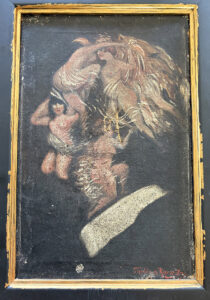
 DD sent me this strange portrait of a male face in profile composed of writhing nude bodies. I KNEW I’d seen this technique before: a mélange of nude women arranged to form a head, a skull, a profile. But WHERE?
In the work of Salvidor Dali of course. In his In Voluptas Mors (Voluptuous Death) he collaborated with Philippe Halsman for a photo arrangement. They stacked and arranged a group of naked females to form a skull with orbital openings, nose, and teeth. Dali and Halsman met in 1941 and collaborated for thirty years. Voluptuous Death shows Dali at the front of the composed photo, in top hat and tails, a circus ringmaster gesturing towards the death-head of full sized female bodies. Dali painted in this style of bodies IN bodies, such as The Face of War, the eyes and mouth of skulls full of skulls like so many marbles. Marvelous, in a style called both surrealism and anamorphic.
I didn’t find the artist who signed DD’s work. He may have been an amateur that happened to discover this anamorphic style. I wonder if he experienced the paintings of Giuseppe Arcimboldo (1526-1593) who not only composed portrait faces from naked bodies, but portraits from fruits and flowers, plants, vegetables, books, animals and sea creatures.
Cabinets of Wonder
Considered the first surrealist before the term became known, Arcimboldo emerged in the 16th century when the wealthy celebrated oddities of nature in macabre ways. Bones, shells, fossils, heads, teeth, skulls entered into personal cabinets of wonder. Likewise, the painter Arcimboldo painted his fanciful and frightening images as “scherzi”—diversions or “capriccio”—for caprices, for jokes and laughs, for amusement at the strangeness of the world. Five hundred years later the artist of DD’s painting expressed his strange way of seeing a man’s face: through female nudes.
Feminist critics point out that men don’t inhabit the female body, nonetheless they exerted control over the female body’s representation throughout cultural history. Think of works by Michaelangelo, Da Vinci, Rubens, Goya, Picasso, Dali, Arcimboldo, and now DD’s artist!
Similarly, a painter in the 19th century, Filippo Balbi (1806-1890) created heads of males composed of nude figures: Head of a Man Composed of Nude Figures Wrestling.
Arcimboldo Inspired Dali and Other Surrealists
Like Dali, Arcimboldo worked in cycles. He did portrait representation of the four seasons, the four elements (earth air fire and water). He also did what looks like insulting caricatures of Royal and court personages, such as Rudolf the 2nd and his officers in fruit, in naked bodies, in fish. His reimagined heads as edible arrangements of food for Royal patrons created visual feasts. This is the tradition from whence DD’s portrait originates.
X rays of Arcimboldo’s canvases from the 16th century show he worked upside down, using still life before their time. WHY? He felt drawn to the curiosities and grotesqueries of nature., and his customer base laughed along with him.
If You Like Surrealism
I suggest you fly to Paris, where on Avenue Hoche on March 26, Bonhams and Cornette de Saint Cyr will hold an all-surrealism auction. In fact the most expensive photo ever sold, $12m having been shown at the MET in a show called When Objects Dream 2022, is a surreal 1924 photo Le Violon d ’Ingres by Man Ray. Ray transformed a woman into a violin. This was his photo of the jazz singer Alice Prin, or Kiki of Montparnasse—the bohemian neighborhood of Paris in the 1920s. He photographed her from behind, wearing nothing but a turban. On her back he painted two black f-shaped acoustic sound holes, the kind you see on a violin. He “hollowed” her out to be played, as it were!
At the website Postcard Guy DD might, for $40, purchase a 1910 postcard called L’Eunuque where for a private gentleman’s’ delectation, he might in 1910 have owned a postcard of a man’s face composed of naked women. Another face composed of naked people was created recently to promote an Australian TV show called Who Do You Think You Are?
The relationship of bodies to faces is integral to how we think about our humanity, as we see by DD’s macabre portrait. The value is unknown.