 At age twenty I worked as a dancer in Michigan with a touring company of Showboat. I loved the Grand Rapids area. One day off in the late 1970s I toured the Widdicomb Furniture Company’s Museum of Historic American Furniture. They included modern furniture in the display. In their later years, they closed in 2002, Widdicomb affiliated with two of the world’s greatest Modernist designers, George Nakashima (1905-1990) and T H Robsjohn-Gibbings (1903-1976).
I remember studying the catalogue at the little museum that defined “modernism in furniture:” a post WWII use of industrial materials for elements in design, the influence of Classical architecture, furniture no longer an “ornament” but “usable,” a focus on “functionality” in the manufacture in use and in total design aesthetic.
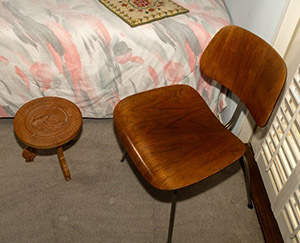 Modernism came closer to a devotedly held elitist religion and philosophy than in any era in the history of design in the past. Although its philosophy centered around non-elite, affordable machine-made furniture. A testament to this new philosophy, that design was/(should be) art. The Museum of Modern Art in the 1930s dedicated a department, Architecture and Design, to furniture and industrial design as well as architecture. Great architect Philip Johnson (1906-2005), who designed in the geometric style, a force for 75 years in the history of the builting environment, headed the department. Among his many achievements, he designed the sparely beautiful Glass House, built between 1949 and 1995, a National Trust Historic Site today, located in New Canaan, Connecticut.
Woodworker George Widdicomb founded Widdicomb in 1858. When George’s four sons enlisted in the Civil War, the little cabinetmaker’s shop dissolved. But when one son returned from war, he opened a furniture shop at a new location in Grand Rapids.
Grand Rapids Becomes Prominent Furniture-Making Hub
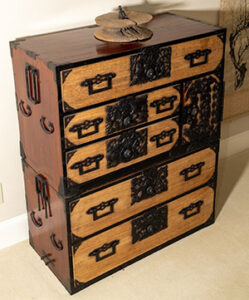 Surrounded by timber forests of pine, walnut, and oak, the Grand River became a prime source for hydroelectric power, creating the US woodworking hub. Soon after the 1890s, the city’s nickname was “Furniture City,” thanks in part to Widdicomb furniture’s growing popularity. In 1891 the company shipped bed frames, chiffoniers, bedroom furniture (mirrors, nightstands, dressers) to far off US cities in various “Revival” styles—far from their modernist look to come!. Revival designs at Widdicomb featured their popular spindle, American colonial with ornately turned wood posts, beds. In those days the style for furniture for the bedroom included two single beds! We see those today at every garage sale.
America from the 1890-1920s favored furniture that harkened back to previous historic periods. Widdicomb designed in the “Louis XV” French Revival style, the “American Colonial” style, the “English Georgian” style, the “Italian Renaissance” style (think Hearst Castle). John Widdicomb served as the main “Revivalist” designer well into the late 1930s. As the pendulum of design swings, this era that hearkened back to the past changed on a dime to the modernism of the future.
Modernism of the Future
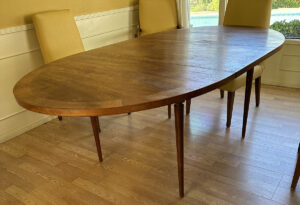
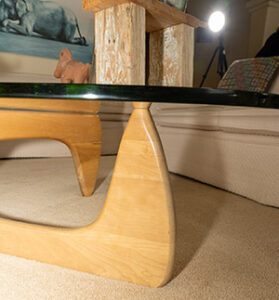 Until the 1940s Widdicomb manufactured traditional styles, until the company hired one of the most sought-after Modern designers of his day, T. H. Robsjohn-Gibbings. Before he came to Widdicomb, he designed houses and furniture for Elizabeth Arden, Neiman Marcus, Doris Duke, publisher Alfred A. Knopf, and Hilda Boldt Weber, for whom he designed Casa Encantada in Bel Air (1934-8). From 1943-56 he worked as lead designer, bringing his signature Grecian (severity) Art Deco classicism to mix with Scandinavian, emphasizing clean craftsmanship/austerity, design. Incompatible, you might think, but reader CM sends me a great example of T. H. Robsjohn-Gibbing’s work, a dining suite in walnut, which artfully blends Grecian lines with Scandinavian craftsmanship.
The set includes a china cabinet, with the flat, unadorned wood surface featuring Classical tapered feet and drop-brass hardware, more Grecian than Danish. The sideboard is similarly designed as is the table with its classical tapered legs. The dining table includes six chairs, straight-backed, no decoration. The geometry of the furniture speaks for itself, in Minimalist design.
CM Asked About Value
A walnut “X” base dining table from 1943-56, designed by Robsjohn-Gibbings, with similar chairs sold for $5,400 at Rago Auctions, as did a 1949 dining suite in walnut (with label) for $5,600. A pair of dressers, also in light walnut, from the 1950s sold for $2,900.
CM’s suite is in great condition, and lovers of late 1940s early 50s Modernism will likely pay $6,000 for the suite, with its original label crediting Robsjohn-Gibbings. CM may sell. Email me to connect you.