 I visit quite a few homes each week to appraise contents and collections. In almost every home I find a “knock-off” Phillippe Stark Lucite see-through “Louis Ghost” chair. They’re made of Lucite or acrylic resin with that round back rest, arms, and tapered legs. Today they cost as little as $49.
The Lucite glamourous furniture fad began in the 1950s. In the 60s Frank Sinatra, Dean Martin, and Tennessee Williams commissioned expensive high-end designers to create furniture for their estates. Charles Hollis Jones became known as one of the top paid designers, an American artist and furniture designer recognized by the Smithsonian for his pioneering use of acrylic and Lucite in interior design. He earned the moniker “Mr. Lucite.” His credits as a designer recently, he’s still around in LA, include Stallone and the Kardashians.
What began as industrial use only in the 1950s became extra chic, even highbrow, art in the hands of Charles Hollis Jones. He took polymethyl methacrylate and made it hot—dare I say sexy.
Jones Beginnings Not “Hot”
Brought up in Bloomington, IN a carpenter’s son in 1960-70s he experimented with unconventional shapes in Lucite. Thank him for the elegant brass, glass, and Lucite dining tables prestigious in the 1970s. When my father created his bachelor pad after he divorced my mother, he ordered an inexpensive knock-off of a Hollis-Jones design. Here’s where Lucite takes up a single swinger mentality: the newly eligible bachelor turned away from his ex-wife’s Colonial style rooms, and went brass, glass, and Lucite. Not to mention slathering sofas with vinyl upholstery fabric in HOT colors, remember? My dad got a white shag rug and bright vinyl recliner chairs, not a great fit for a humid Illinois farm town summer.
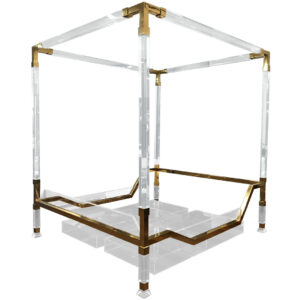
I bet my father wished he afforded the sexiest of all Hollis Jones’ designs, a four-poster canopy bed in Lucite and brass (1971), handcrafted, accented with vanity tables, lamps, in Lucite with metallic details. Bob Hope commissioned a bed from Hollis Jones, not sexy—he upholstered his Lucite bed in blue floral fabric. Jones also created a wraparound Lucite bed for Elvis, totally hot with mirrors all around the circumference.
Yes, Mom did her house in Deerfield Illinois in Colonial Revival, with maple Ethan Allen furniture. But our home in Deerfield in the 1980s contained Lucite too, Lucite serving trays, Lucite nut bowls and ice buckets for cocktail hour, and some cheap jewelry. Highbrow had trickled down to mid-western low brow! By the late 1980s the fashion for space-age “disappearing ghost furniture” Lucite waned as Lucite became tacky and overused. My dad road the cutting edge of the ‘tacky’ downswing.
Lucite Makes a Return
In the 2020s, Lucite, in all it’s over the top “invisibility” isn’t only hard to find but vintage Lucite is expensive. That Charles Hollis Jones brass and Lucite “Metric” king-sized poster bed from 1971 now costs $50,000. You will pay more, however, for the four-poster designed and manufactured by Hollis Jones for Sylvester Stallone in 1976. In fact it’s for sale today. Stallone requested the ceiling of the bed between the four-posts have a mirror, however, the mirror is now missing. It’s hard not to wonder what that mirror reflected.
A while back from the 1970s, the Lucite in Stallone’s bed was conceived of by scientists in 1930 who designed an early form of acrylic resin molded when heated into a flexible, crystal-clear plastic. DuPont coined their formula “Lucite” in 1937 and began to produce industrial sheeting. By the 1950s designers deemed the clear stuff “Space Age.” Pierre Cardin in 1960 developed “Lenticular” furniture, cradling an optical illusion inside the molded Lucite in wavy patterns.
So “Palm Beach,” Sidney Mobell created Lucite etched with seashells, tropical palms, and dolphins. His creations are the ultimate 1970-80s Palm Beach (Kitch) experience, yet a dolphin side table will set you back $5,000.
JE sent me a find from Oxnard’s Habitat for Humanity Re-Store. It’s a Lucite “back of sofa” table, which I date from the late 1980s. Note the geometric legs which give it away as the look of the late eighties was chunky and massive as opposed to the earlier more refined elegant line. This dates from the downward slide of Lucite furniture into “low brow.” The value is $1,000 for such a table in good conditions: yes, Lucite can scratch.