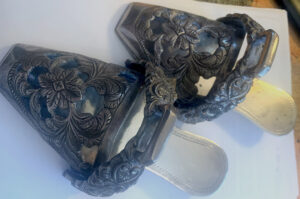
 PS asked about a pair of silver stirrups, necessary for riding a horse. Imagine a time before cars in our world, and we rode horses—or they pulled us. For thousands of years we’ve recognized stirrups as form. PS wonders if her pair of stirrups are decorative or if a lady equestrian used them. When? Where?
South American Stirrups
These are South American stirrups, dating from the early 19th century. They’re SO SMALL that I, too, suspect they’re lady’s stirrups, from a time when women prized dainty feet. A lady used them in 1820 or there abouts. At this time, when these stirrups came into the world, most women had on an average of five kids. Who’s feet remained SMALL after carrying such a load?
Let’s see how universal stirrups were in the 19th and 18th centuries, and how plentiful the relics of them ARE. Few stirrups are worth much in the marketplace as “equipage,” a word meaning objects related to carriage via horse or horseback. That market is strong and active.
Firstly, let’s look at the ‘’encased foot’ form of stirrup. Spanish Colonial riding stirrup from the late 18th century, with a curved toe, echo the Moorish heritage of Spain. An ornate element, a beautiful, foliated band with a small slot attaches to the saddle. Those only set you back around $300 for an antique pair, because many existed. In Old Spain they copied silver stirrups from the Moorish SOLID BRASS stirrups. In New Spain, of which our California belonged to, one found stirrups much the same.
Stirrups From Other Countries
Japanese stirrups of the late 19th century, called “Abumi” are also small, but in a “C” shape. They don’t encasing the foot, but rests the foot on the bottom of that “C” shape. Beautiful in their simplicity. These are made in bronze and brass and worth $1,500. If you find a pair of Abumi cast in iron with a beautiful gold-gilt inlay, you have something valuable. I bet you think they’re modern abstract works of art, and you might never recognize they’re stirrups from the 19th century. They’re so beautiful you cannot imagine feet perched in them as a rider must do on horseback. In a wonderful curve in a C shape from the Meiji period 1868-1911, they sell for upwards of $2,000 the pair.
Something more recognizable is the American Old West stirrup, functional and still used in original form today, also with Spanish influence. An interesting sideline for collectors of “equipage,” some American stirrups created to support political candidates! Thus, in America of the 19th century, stirrups supported something other than the FOOT.
A case in point are the stirrups made for the candidacy of Henry Clay, the Speaker of the House who ran in the 1844 Presidential Campaign. He loved horses. From the State of Kentucky he bred horses, so his campaign created stirrups with an initial band which read ‘HCLAY,’ on which you might rest your feet.
Henry Clay lost his bid for the presidency. But he raised a famous racehorse, the greatest horse of the 19th century, the sire of America’s National Thoroughbred Trotting Horse. The horse’s progeny became the magnificent “Clay Line” of great trotting horses. The horse passed away peacefully in 1867. Named after human political candidate Henry Clay, the horse was exhumed, and his mandible put on display at the Smithsonian Institute in Washington DC.
Silver or Not?
PS, your stirrups aren’t sterling at all. Sterling contains a great deal of pure silver. Your South American stirrups are made of Brazilian Britannica Metal, not containing much silver content at all, in the style of Conquistador Stirrups from the third quarter 19th century, made for a lady rider with flouncy gowns to match these stirrups.
The great Brazilian “equipage” ironmonger Correa de Lima, of Rio de Janeiro (1861-1873) made the best of these South American lady’s stirrups. A similar pair sold at New Orleans Auctions for $300.