 In 3300 BCE, Otzi the iceman was murdered high on a mountain between Italy and Austria then buried in a glacier until 1991. At the time of the murder diverse ethnic groups settled the area between the Caspian Sea and the Black Sea (Georgia/Armenia/Azerbaijan), gradually leaving areas of the world becoming arid.
Nomadic groups flowed through the Caucasus region. They camped near water or in the mountains near streams. The world began to change. Otzi might have foretold nomadic migrating people needing transportable durable textiles for bedding, bundling, shelter, and storage. In the early days in the Caucasus region, they made flat-woven, non-pile rugs for durability and longevity. If Otzi visited the region between Europe and Asia, a long walk since they discovered him in the mountainside between Italy and Austria, he’d have met the artists who originated C’s style of rug.
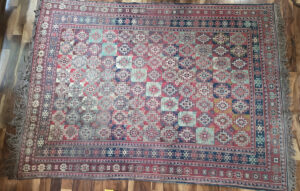
C received this rug as a gift. Should she insure it?
In my book, No Thanks Mom: The Top Ten Objects Your Kids Do NOT Want, one of the top ten is Persian style rugs. The market puts a great deal of influence on value. Mid to late thirty year-olds don’t want eyebright colors and dizzying geometries of a Caucasian rug, although they come with a ancient, rich history. So C’s rug isn’t worth much in the market, even though photos show it’s pre-1925 and made with handwoven wool and natural, non-chemical, dyes. It SHOULD be worth more, and thirty years ago WAS worth more than today. So no, C, don’t insure it because it’s not worth more than $800 replacement value. Less if you use a standard of value called fair market value, the most common price paid in the relevant market.
Now that I delivered the bad news, let me cheer C up with the history of the ancient era her rug came from. The first patterns emerged in the 4th Millennium BCE (4000 BC to 3001 BC), the Bronze Age.
Caucasian Soumak Rug History
Before the development of cuneiform writing, weavers practiced the pattern and method in C’s rug. Weaving, the potter’s wheel, and linen making developed in this era in the city states of Sumer, in the Caucasus, and Egypt. The world practiced animal husbandry and agriculture, as weavers in the Caucasus made rugs for individual, nomadic tribes. The world’s population doubled in the fourth millennium, over a thousand years. Patterns in their rugs echoed animals, nature, the cosmos, with each tribe making their own shapes.
While weavers wove, other parts of the world saw the invention of mathematics, astronomy, astrology, a kind of civil law, the sailboat, and the wheel. Also the potter’s wheel. In Iran, not far from the weavers in the Caucasus, the first pots were thrown. All over the world ethnic peoples practiced art for no reason except to picture their world in a symbolic, some say religious, fashion. As weavers created the first Caucasian rug, an artist in Spain painted the walls of their cave shelter with animals, shaman figures, and hand prints too. So although C’s rug isn’t a huge treasure in the market, it’s a reminder of the dawn of the applied arts.
Let’s Jump to the 19th century to the first quarter of the 20th century when C’s rug came off the loom. Russia took over Caucasus and Russian traders made certain regions in the Caucasus major exporters of this style of rug. Kuba, Shirvan, Kazak, Dagestan, Karabagh, used the old symbols executed in geometric forms in handspun wool and natural dyes. After 1925, this changed. The growing popularity of Caucasian flat weaves, highly colorful rugs meant mass production began with mechanical spinning of wool and chemical dyes, and less individualistic patterns and symbols.
C., a great difference exists between VALUE and WORTH.