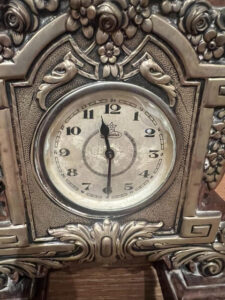
 Art Deco clocks are special to me. My mom recently passed “out of human time” and into the next realm at the age of 96. She collected clocks, especially those that reminded her of our city of origin, Chicago. Those in the Midwest version of the Art Deco style, called “Prairie Style,” in the 1910-1920s.
The best days of Art Deco clocks happened 1910-1920s, when hardly anyone afforded them. BB sent me an example of a cheaper, middle-market clock from that time period. This Neiva Company clock shows all the hallmarks of the Art Deco style, reimagined for middle class buyers in the 1930s. Notable companies in the 1920s produced the top designs of the Art Deco period clock. Buyers of high fashion who couldn’t afford European designer clocks opted for the “look” of reproduced “lower brow” Art Deco such as we see on this Neiva clock, as the style morphed in the 1930s.
Why are Art Deco clocks important to me?
When I turned thirteen my mother took me to Marshall Fields to buy ANY book I wanted. I remember the Louis Sullivan clock hanging over the front of the stately store. To commemorate my birthday a relative bought me a miniature table clock version. That model came with a pewter repousse front, and a flat back. Lenox produced this reproduction for a desktop in the 1970s. The “look” was sleek, made of metallic finishes, sophisticated but cheap.
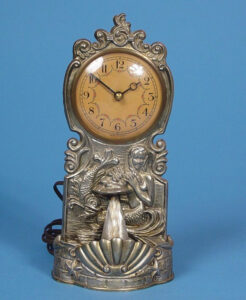 The clock BB sent me is the re-do of that style, a low-brow Horology, the Art Deco clock for anyone’s mantel piece in the 1930s. The face isn’t sterling, like some of the best clock of the era, and not in that elegant style. Neiva, not a notable clockmaker, made this kind of kitschy version. This OTHER Art Deco clock IS kitsch. You see the mermaid dumping the sands of time into the ocean.
Three of the most influential designers made the finest Art Deco clocks. Romanian sculptor Demitri Chiparus (1886-1947) designs for clocks included exotic dancers, elegant women with Borzoi dogs, and mermaids. Only the wealthy afforded these. However, you see where the mermaid figure comes. If you can’t afford a Chiparus figural clock, you CAN afford a silverplated Mermaid Clock—that’s electrified.
This gives a great example of the ‘trickle down’ of a style, which must become affordable to “trickle down.”
Art Deco Clocks Feature Figures
Many great and expensive Art Deco clocks feature figures: panthers, dogs, faun, mermaids, dancers. Great “animaliers,” sculptors who created well-wrought animals in France, such as Michel Decoux (1837-1924) created clocks topped with elegant sleek animals in bronze, sterling, or marble. These clocks, in design, about ten years later, ‘trickled down’ to the middle class and such American Companies such as Ansonia created figural clocks in silverplated faced fronts, and a cheaper, sometimes brass plated, dial, with figures that aren’t exactly artistic.
Finally, another designer from the early 20th century, Joesph Lorenzl, became famous for sexy females perched on top of a mantle clock, designed in marble. He crafted the figure in bronze. In the history of Art Deco sculpture, nothing is more notable than the figures designed for mantel clocks. Companies in Europe such as Japy Freres, Samual Marti, and the Junghaus Company made Art Deco mantel clocks that only the wealthy purchased. A reversal of the trend towards luxury occurred when the German Bauhaus designed their clocks. This is that niche in Art Deco design that became geometric, elegant in linear way, and the Bauhaus Art Deco clock leans heavily on the new design field called Industrial Design.
BB’s clock STRIVED toward elegance, imitating those made of the highest and most valuable luxurious materials. But I don’t see anything streamlined and elegant about this Neiva clock.
The value of the Nieva clock is marginal, but the example of it is powerful. Every high style “trickles down” to a lower-brow style, and this clock is a great example of that in the early 20th century. Price? $150.