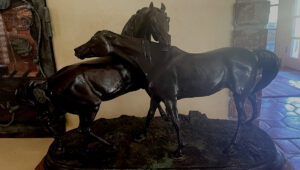
 B and J sent me a beautiful bronze sculpture of two horses, one smaller, one larger, facing each other, with the head on the shoulder of the other. B and J asked if this is an original by Pierre Jules Mene (French 1810-1879), a great sculptor of animal figures. Collectors call him an Animalier, a type of sculptor revered in the late 19th century in France for his figures of animals. The work of great animaliers sold well in England, a country known for hunting, racing, and blood sports in general.
The art world considers Mene one of the greatest sculptors of animals in the last part of the 19th century. I love the title of this work in French, L’ accolade: Groupe de chevaux arabes. The word “accolade” acted out, anthropomorphically, by the larger horse. It seems the smaller horse, an Arabian of perfect confirmation, won a race, and the larger horse caresses the little horse’s shoulder. This illustrates the exact meaning of the ancient word “accolade.” In Medieval usage it meant the touch on a future Knight’s shoulder of “grace.” The accolade made the man a Knight forever. These horses are part of that ceremony, a conferring of an honor, recognition of an award, praise by a superior, that confers prestige.
A Bronze Sculpture
To tell the truth, I find it hard to say if it’s original or a re-cast. A recast is so easy to do, only ascertained by an expert who looks closely at the seams in the bronze. A recast means the original bronze was “fitted” with a paster overcast, then “reversed” into a bronze based on the negative space of the fitted cast. An original bronze is created from the interior mold, the exact opposite technique of an overcast.
The market in the late 19th century didn’t differentiate much without copyright issues. Any bronze foundry reproduced a bronze—signature and all, as that signature is part of the “relief” of the bronze. Values therefore are subjective. Unless a connoisseur verifies a work is an original bronze, the market pays similar prices for a Mene “After” the original or an original Mene. Animal sculptures are always popular, especially bronzes of well-done horses, such as L ‘accolade.
Other works by Meme are diverse and—for a change—not related to the hunt, not a popular theme in bonzes today. Some of the titles sold include Chasse au Lapin. Also, a chase for a fox, where Mene sculpted a Groupe chiens au terrier in 1853, dogs eagerly look down a fox hole, to no avail. This work sold at the Continental auction house De Vuyst for $4,000.
Another work also “after” Mene, a reproduction albeit a good one from the late 19th century, is a cold painted bronze. This means the patination of the bronze is a painted surface. It shows a pair of setters and a pointer and sold by Bonhams Skinner this September for $700.
Other Types of Sculpture
Mene also did “putti,” baby figures which played with or held animals. A naked figure by a follower of Meme: Paar grosse puttenfigurern mit Fisch auf einer Kugel Sitzend, (a pair of cherubs holding large fish sitting astride a globe) a delight for the 19th Century connoisseur. This sold for $600.
Another style of the last 19th century went hand in glove with the animalier style, the exotic horseman. These depicted mounted warriors astride steeds from China, the Arab countries, and Africa, all noble and all dressed in exotic costume. One by Mene holds a European style weapon, Reitender Afrikanen mit muskete, a large work at twenty-five inches, sold in Dusseldorf for $4,900.
The most delightful of all sculptures by Mene shows a confused little dog. Sentimental and anthropomorphized, an animalier bronze called Chien et Pigeon, depicts a griffon hound quizzically gazing on two pigeons at his feeding bowl, eating the dog’s dinner. The dog cocks an ear in wonderment. This sold at an English Auction called Dreweatts for $800.
The Pierre Jules Mene sculpture ‘L ‘accolade,” owned by B and J D is valued at $5,000.