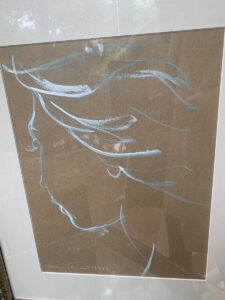
 MN enjoyed buying storage lockers whose owners defaulted on payments. He bought one in the early 2000s in San Diego and stuffed boxes of books and papers into his own storage locker. Once retired he sorted through those boxes. In one old box he found a diary and sketch book of a renowned Hawaiian artist, Madge Tennent (1889-1972). He framed four of the sketches. What do I know about finding lost art, he asked?
I know you find art in the strangest places, and once you do, it’s almost impossible to trace how the artist “lost” their own work. Unless an artist knew since putting pen to paper at ten years old that they planned to change the face of art history, artists typically don’t establish their own archives, and catalogue their works. That’s left to family members later, if they’re lucky. Artworks DO show up in odd places. One of the tests of a true connoisseur is this question: “If you walk into a dirty garage in a run down house, do you recognize the Kandinsky leaning against the wall?”
Madge Tennent’s work in oil sells for between a hundred thousand and a million dollars. Her small watercolor line-drawing portraits, such as the four framed by MN, sell for $1,000 to $2,500 each. Not sure what the sketchbook might bring. Bonham’s Auctions is a leader in sales of works by Hawaiian artists. MN should take photos of all for an auction estimate. He doesn’t need to sell…
Tennent: a Free Spirit Before Woman’s Lib
Born in England to progressive parents who welcomed all religions and races, her family moved to South Africa. When Tennent exhibited prestigious artistic talent at twelve, the family moved to Paris. She studied art at the Academy Julian under famed William Adolphe Bouguereau. Returning to South Africa, she met a soldier form New Zealand, married, and on the way to London stopped in Hawaii in 1923. She never left.
She discovered the beauty of the islands and the people. Although she made her living painting portraits of upper middle class people like herself, she began to paint the ‘wahine’ of Hawaii. With each portrait her canvases grew larger and her palette more colorful. She eschewed the brush for the boldness of the palette knife. Her love for the people of Polynesian and their heritage grew. She wrote, “The women are a perpetual and queenly benediction from an island possessing the most beautiful people of the world.”
The world Discovered Her Work in the 1930s
She exhibited at the Honolulu Museum of Art, and showed her Hawaiian themed works in New York City, Chicago, and Europe from 1930-1939.
She experienced her first heart attach in the mid 1950s. MD’s portraits are signed and dated: two from 1955 and two from 1956. After her illnesses she concentrated on small intimate sketches, some of Hawaiian Royalty which she considered gods. Her charcoal portrait sketch of the beautiful Princess Kaiulani sold for over $1,000.
From 1955 to 1965 she struggled with heart ailments. She finally moved permanently to Maunalani hospital where she died in 1972.
MD didn’t know the name of the former owner of the storage locker where he found Tennent’s work. Nor did he know Tennent’s son Arthur Cowper Tennent who established the Tennent Art Foundation in the mid 1970s. MD remembers the storage locker contained fine Persin rugs, and some other items he sold, but he doesn’t remember any other works of art. This leads me to believe the owner of that storage locker wasn’t an art collector, but a friend of the Tennant family. Someone with whom Madge entrust a sketch book. Her first marriage ended in divorce in 1914. My research indicates that first husband Bertie Phillips Denham was a English journalist, not a San Diegan! Her second husband died in Hawaii in 1967.
In 2005 her son Arthur gave thirty oils and forty works on paper to the Hawaii Preparatory Academy, establishing the largest collection of other works outside the collection of her teenage friend Donald Angus, who owned at least fifty-three drawings. Now MD discovered he owns many more than the four he framed!
Art is found where you LEAST expect it.