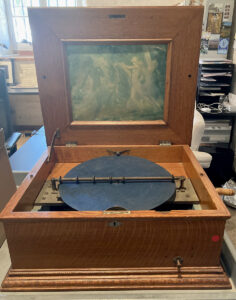
 Imagine a breadbox-sized box with a round metal disk inside, a music box with a coin slot for a nickel. In 1900 one found this box in taverns, pool halls, and front parlors of middle class American homes. This early music technology played one song at a time. Each box came with a few disks, so you heard only a few songs from this late 19th early 20th century “entertainment” centers.
AA sent me a little twenty by sixteen by eleven oak music box designed for front parlor musical entertainment, affordable on a middle class budget. The German firm Syphonion Musikwerks patented the star flywheel, allowing them to corner the market on parlor music boxes in 1890-1910. These boxes aren’t valuable today.
The Bigger the Disk
Rare, and expensive, at the time, the five foot tall centerpiece furniture Symphonion music boxes contained a twenty-five inch diameter disk. These revolved vertically until the song finished. With some effort, the man of the house changed the disk, and played a new song. The larger the disk, the longer the song played, a desirable feature. These large disks are ‘double combed,’ meaning each upright “pin” strikes a metal tuned bar as it revolved. The huge disks consisted of up to two-hundred notes, offering a rich sound.
The larger the disk, the more showier the carved walnut or mahogany box, which often became the central feature of a room. I noticed Renaissance Antiques in Solvang displays an ornate Symphion with a large disk, offered for upwards of $20,000.
This disk technology, developed by German engineers in the late 19th century, supplanted the automated Swiss cylinder music boxes. The cylinder was harder to change, and difficult to store. Think of the difference between a round tube of metal versus a flat disk of metal. Most finer music boxes with disk technology came with a storage area in the box for additional disks, but a library of ten disks was rare. The household listened to the same five to ten songs repeatedly: No Spotify yet!
Symphonion Musikwerks Began in Leipzig in 1892
The company took over all levels of the market, from the middle class three disk parlor model, to the high-end centerpiece of the house, the upright disk music box.
Echoing the turntables of the DJ’s to come, one 1910 model featured TWO disks in one box. When one disk finished the song, the other disk played. But the analogy to a vinyl record ends there. With the metal disk music boxes, single pins placed at a certain distance from the center of the disk triggered individual notes. When the disk completed its full circle the music ended, unlike a vinyl record which moves through its spiral groove.
Music Boxes Come to US
One employee of Symphonion decided to export the flat disk music box technology to the US. He started his own music box company, Polyphon. Polyphon became the company with the more accessible name, Regina, the dominate seller of music boxes in the US for fifteen years. Smart and savvy, this young inventor developed a proprietary SIZE disk that ONLY played in Regina music boxes. The company name, Regina, became the generic name for a late 19th century music box in the US.
What kinds of songs played in the parlors and pool halls of the late 19th century? A Syphonion box sits in the collection of the Media Theory Department of the Humboldt Universität zu Berlin. Its disk plays a rendition of the march “God Save the Hapsburgs,” arranged after the original song by Jospeh Hayden. He penned the song in 1797 as a personal anthem for Austria’s Emperor Francis II.
The Syphonion music box in the University’s collection in Berlin contains a march arranged by a bandmaster named Johann Nepomuk Kral (1839-1896). I’m surprised that the Johann Strauss Society of Great Britain deemed Kral as “world famous” for his 1886 composition “Hoch Habsburg.” Kral conducted military bands but found the time to write dance music, polkas, and waltzes.
The value of the little disk music box from 1900 is $800.