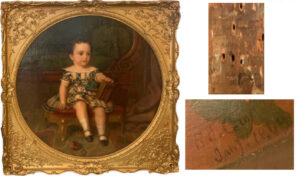
 In many collections of American portraits of young children from the 1830-70s we ‘moderns’ cannot distinguish the genders of the sitters. SC sent me a little portrait of a child in a tartan dress: a case in point.
In 1850 the average American family size included six to nine children. Boys in the early to mid-19th century wore dresses handed down from sisters, typically termed frocks. These frocks were worn without either short or long pants underneath until a boy reached “breeching” age. A young boy reaches breeching age when he holds his own and doesn’t soil his breeches. Parents with both male and female children know boys are harder to potty train. Thus, “breeching” became a term used to describe the proper time to allow a young boy to wear breeches under a tunic. Younger toddlers in the 19th century didn’t wear gowns as they impaired freedom of movement, they wore tunic dresses, and diapers.
SC named her child portrait “Biddy’s Girl,” when in fact many elements point to it showing “Biddy’s Boy.” I date the portrait and gender by the clothing style. The little chap wears pantalettes, not knee pants or knickers. This was the fashion for both sexes until 1870 which a “breeched” boy wore a knee pant. By the 1870s boys often wore a stylized jacket and waist coat over a skirt, not a kilt, but a skirt with box pleats.
Hair styles also unisex
Boys often wore long hair pulled back with a small bow. Later in the 19th century girls wore larger bows. The fabrics used were unisex. Both young boys and girls wore wool, fastened with hooks and eyes or buttons at the back. Garments didn’t differ for the genders until each of the sexes reached at least seven-years old. Publication of the book Little Lord Fauntleroy made European ringlets and velvet long trousered suits popular for young boys in the 1880s.
Originating in Britain, both genders wore tartans from 1850-70, but due to the popularity of sailor suits in Germany (1860-70) and Highland wear (kilt suits) in England boys dressed in sailor collars and tartan tunics. Both sexes worn sailor or Highland tunics until a child’s ninth year with either pantalets or tights underneath, preferably striped tights. The traditional Highland kilt was transformed into an American jacket and skirt in tartan for boys. By the 1880s large collars for boys with knee pants came in vogue, with large floppy bows at the collar. Still, up until the age of eight, a young boy wore what we now think of as a dress, in either cotton or wool, with bows.
Who’s the Artist?
The owner of this little “Biddy-boy” portrait wants to know the artist, and if the artist sells for much. SC also wonders about the importance of this Americana artist. That’s not really the focal point of this little work, not all well painted. I found the signature almost indecipherable. It looks like A. R. Cu… or R.A. Cl… However, the artist of such a work, in this case, isn’t as important as the quality and style of child’s portraiture.
They called this style a “genre” painting when the 19th century viewer could identify the child’s nationality and class. Although we don’t “see” the gender nor the class or nationality clues today. This Biddy Boy child wears a finely made tartan dress. The child holds a little concertina, and he’s played with a ball (painting, dated 1869). The furniture in the painting is Renaissance Revival, purchased only by the affluent, and the carpet comes from “Turkey,” imported by the rich. The child’s face isn’t well-executed because the point of the painting is to place the child in his “class,” not to accurately portray the little boy.
I suspect the artist was Mary Anna Randolph Custis, the wife of Confederate General Robert E. Lee. An average painter of Virginian children, she sold her works to benefit the Confederacy. This style of children’s portraiture was ubiquitous in this era. The frame is also late 1860s.
The value, if by Custis Lee, is $1,000. The flavor of the interior furnishings in decidedly Southern American dating from the mid-19th century and places the child in his status as a well born Southern American gentrified child, likely a first born son.