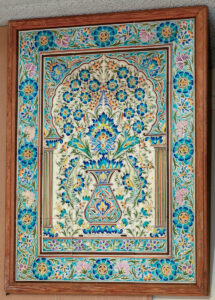
 FF sent me a ceramic tile, framed, with a delicate pastel decoration of stylized flowing foliage in a vase. This Persian symbol for the Tree of Life offers connections between earth and heaven, the afterlife, and potential to burst into life. The flowers are the blessings of paradise, tranquility, fertility. The tree is cypress, the symbol of immortality. Note the pastel palette: light blue, green, and pink in Persian art suggest the tranquil side of Nature. The tree suggests abundance, prosperity and divine gifts. This image offers a power that spans centuries and continents, FF. The spark behind this work demonstrates the cross fertilization of cultures, something you didn’t expect to find at Goodwill.
Google Image Search gave amusing comparisons with other tiles in other places in the world. The tool showed me similar tiles in the UK’s Royal Collections Trust and tiles at a palace in Cuba, as well as the Wiki page of an artisan named Mohamed Boumehdi in Algeria. What do all these references have in common with this three by two foot tile at the Goodwill Thrift last week?
The Culture of al-Andalus
For seven centuries the Iberian peninsula and Islamic culture were inseparable. When Columbus arrived on Cuba on October 28, 1492 he claimed that Caribbean Island for Spain. A few months before Columbus landed, the mighty Granada, the last Muslim State in the Iberian peninsula, fell under the forces of the Spanish Christian monarchy. For seven centuries, Arab architecture, art, and artifacts, dance, and design shaped the Spanish diaspora. We see it on our streets here in Santa Barbara. The influence is a direct reference to Mudejar architecture of the Iberian Peninsula, tall arched doorways, courtyards, fountains, tilled walls….we know them well.
FF’s tile is a wonderful artifact made in the 1980s by the Algeria master craftsman Mahamed Boumehdi. His forbearers then his progeny carried on the tradition of Middle Eastern design in ceramic tile. Queen Elizabeth II received a gift from President Bendjedid of almost this exact work of art on her visit to Algeria in 1980. That tile lives in the Royal Collections Trust, where the facsimile of FF’s tile resides. If FF looks close at the bottom of his tile he may find the artist’s signature in Arabic. Look for that!
The Cuban Connection
The influence of Islam on the Iberian Peninsula came to the Caribbean with Columbus’ ships in 1492. If any of readers have visited the Casa de los Arabes in old Havanna, they might have seen a similar framed tile set in the walls of the enclosed courtyard. The museum, as so many other buildings in Cuba, is redolent of Spanish Mudejar architecture from Granada. Our own Granada Theatre was designed by AB Rosenthal in the early 1920s in this Spanish-Moorish influenced style, inspired by Granada and the Alhambra.
The palatial Museum of the Arabs in Cuba is set in a 17th century building with high Middle Eastern style doors, a central courtyard with a fountain, typical of the Moorish culture, and a peacock named Ali. The museum has showcased Cuban-Arab heritage since 1983, a project undertaken by the City Historian’s Office and Fidel Castro. You will find such tiles in the Prayer Room, and in the forty year-old Arab Union in Cuba, which represents the diaspora and descendants from the Middle East.
I visited Cuba ten years ago, ate dinner with a dance teacher by introduction from my past ballet teacher in Pittsburg. He teaches a famous blend of Flamenco and Arab dance at his school, the Lizt Alfanso Dance School. I learned about the approximately 50,000 descendants of Arab migrants in Cuba and the thousand variations of Arabic Latinized first and last names. Speaking to the Cuban ballet master, I learned that Arabs from Lebanon, Palestine, and Syria came to Cuba 1860-1920 brought another wave of Arab culture, food, and dance.
FF owns a wonderful work of art in his tile, and the value may surprise him. If it’s indeed a work by Mahamed Boumehdi, the value is $1,000.