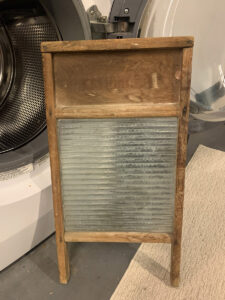
 Why did people use washbats, a washboard, washbox, washing dollies, peggylegs, possers, posssticks, dollypegs, peggy, maiden, plunger, ponches, and punchers? They used these to wash clothes with or without a washtub. Sometimes they used them at the edge of a stream, inside a public washhouse, off a boat, or in the public fountain.
JE owns an early 20th century washboard, the American cousin of the objects listed above. In use by 1860s across the nation but invented in 1833 by Stephen Rust of New York, who patented a wood frame that held a fluted piece of tin, iron, or zinc. These ridges dislodged dirt from clothing. Advertisements for these ran in the mid-19th century. By the later part of the 1800s Herman Liebmann “improved” the boards. This Chicago man replaced the metal plate insert in the board with ridged glass or porcelain. This is the version in JE’s garage.
Laundry Day Ordeal
For years specialist washerwomen performed this task if the family afforded such help. In many parts of the world getting clothes and linens clean happened once a week, or once a month, or once a year depending on the item. Usually the day fell on MONDAY, especially in those traditionally Catholic countries. In many cases it took quite a few days to wash, dry, and fold the linen, and the family wanted peace and no work on Sunday. So easy today to think of a garment dried in the dryer, but even a warm room came hard to find in some parts of the world. In places where most of the year remained rainy and cold laundry became an ordeal. Sometimes they only did it in the sunlit months.
Before the washboard people used washing bats, flat wooden ridged boards with a long handle, used to beat, agitate, and lever clothing from a tub or river. Decorative washing bats appeared in the 18th and 19th century in Finland, Norway, and Italy. Tilted boards with a slope for the water to drain mounted on legs popped up at the sides of rivers or tubs in England.
JE also sent me a painting of washing day in France, in the Impressionistic style, with an illegible signature. But this shows us the early tradition of riverside washing day, a subject beloved of French artists. You see two washerwomen, one in a tub or a three sided box, the other on a ledge with a pile of linen to wash.
Strong Washerwomen
The French made a tradition of the three sided box lined with straw. A washerwomen knelt at the side of the river while the box kept her skirts dry. Across the front at an angle the women held a washboard or bat. One of the women appears to be ON the water, done as well in a small wooden tub at the river edge. Some washerwomen in continental Europe washed on washing benches set in shallow water. The object was to pulverize the fabric. They used different bats, boards, and plungers depending on the strength of the fabric. The object was water flow. Fabrics when wet became heavy which made washerwomen VERY strong.
One travel writer, John Price Durbin, wrote Observations in Europe 1844 noting the “sturdy washerwomen (the job was physically demanding) by the side of French rivers with a washerwoman’s ark (a little wooden raft) or a bench at the side of the water; the bench was used to souse the clothes which would be beaten with a washing bat after soaking in the river…” I love the old word “souse” which means to drown or make sodden, today associated with a “drunkard!”
Communal washing day among washerwomen was common throughout Europe, either at river-edge, in a village washhouse, at the public fountain in the main square. In France, the bateau-lavior was a communal laundry boat moored close to the riverbank.
JE’s washboard is a common antique as most American homes owned one, even after the invention of the mechanical washing machine with a drum in the 1860s. Of course not every American household afforded such a thing, so washboards and tubs were de rigor. Value today is $50.