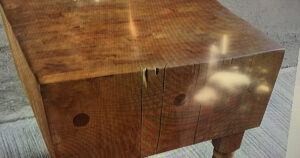
 In my Lake Arrowhead shed lurks a beast, a four-hundred-pound vintage butcher block table. During one of its many laborious moves, it lost four legs and now only the massive top remains. My contractor discovered it and suggested we make it “something” in the kitchen of my 1921 cabin on John Muir Street.
Divine provenance:
That butcher block table will think it came home because it owes part of its history to the naturalist Muir (1838-1914). The founder of the Sierra Club fought against pillages of first growth virgin hardwood forests of the East Coast. Those old growth winter maple forests are the progenitors of my butcher block.
In the 1860-1900 Pennsylvania led the Nation in lumber production. Lumber robber barons, notably the Pinchots of Milford PA, clearcut first growth maples from the Pennsylvania hillsides and trundled them down hillsides to the Susquehanna at Williams Point. They chained and shunted my butcher block, as a tree, through this river’s massive “log booms.” Huge logs stretching for miles: each branded, taxed, and levied.
Son of lumber baron James Pinchot dismayed by the source of his family’s millions, endowed a new school at Yale, the nation’s first graduate forestry program. His son Gifford (1865-1946) became the director of the Nation’s first Bureau of Forestry (US Forest Service.)
At first meeting, John Muir and Pinchot aligned in the matter of preservation vs conservation of resources. Pinchot was a materialist, Muir a spiritualist. They warred over Pinchot’s Hecht Hetchy dam at Yosemite. Muir, a friend of Presidents by now, lobbied for the formation of the Nation Park Service (1917). The influential editor of The Century Magazine, fellow camper with Muir in Yosemite, Robert Underwood Johnson (1853-1937), championed Muir and his formation of the National Commission to Preserve Yosemite.
My Butcher Block LIVED This History
It came from an East Coast butchering family who relocated their business in 1920s to San Diego. I bought it from their son’s kitchen and scraped off years of grease. My piano mover brought it to a (bad) boyfriend’s household. He stole its legs to spite me when we broke up. In heartbreak, it moved to Santa Barbara and legless spent fifteen years in storage.
I gave it to my son, thinking he’d make new legs for it. Didn’t realize his wife might not like four-hundred pounds suspended above her two kids under three years old. So the butcher block came to John Muir one more time since it last saw him in 1890s on John Muir street.
Known for its rugged durability, butcher shops and hog famers clamored to buy four-hundred pounds of maple stacked block on block, bolted together on four legs. Those bolts needed tension adjustments for the climate. Pork production became nationalized after 1920 and the neighborhood butcher became obsolete. The boards made of seven-by-four maple stock sixteen inches long, two inches wide, with the ends stacked as end grain, glued together edge to edge. The end grain was easy on knives and remarkably self-healing when cut, as the wood fibers closed up. Some modern, paltry, five inches thick butcher block counter tops are edge grain. The cutting edge offers high moisture resistance.
Love Boos Blocks
I’m a lifelong lover of butcher blocks as I own three huge Boos Blocks. Each Boos is stamped with the year and month since its founding in Effingham IL in 1887. Conrad Boos developed a impact absorbing table for his blacksmith. Before a national linkage of railways, each little town had a wood-smith who made butcher blocks. When trains dominated in the 1890s John Boos purchased winter maple and shipped his blocks all over the country. Successful, he showed a Boos Block in 1900 at the Paris World’s Fair.
By WWII, Boos supplied the US Army, Navy, and Marines with butcher blocks and counter tops including those on massive aircraft carriers. Sadly in the 1990s food safety guys declared wood a germ repository and recommended polyethylene plastic boards, now found dangerous to humans and the environment. I’ll keep my four-hundred-pounder I think. Value? $800-1,000.
Fun to read about the travels of these Butcher blocks…always wanted one. The Boos company story was educational to learn about.