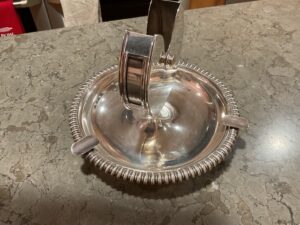
 Coops sent me a fantastic piece of ancient history—an ashtray, classy looking in silver with a cradles for cigarettes. Now collected in a class of objects called tobacciana, vintage from the days when most of us smoked. This ashtray contains something round and silver springing from the middle top surface. Her grandparents smoked: she, cigarettes, he, a pipe.
Nothing I found resembled this round shape on the top of the ashtray. it HELD something integral to smoking. Coops showed it around. People thought the center round thing held matches with the slider on the side used as a striking surface. I think it held a lighter because the round thing detaches from the ashtray. It’s heavy even without the centerpiece, which shows lines of threading which requires several counter clockwise spins to undo it from the ashtray. In any event it’s a curiosity.
Yes, Ashtrays Are Now Collectables
It’s also curious to think that smoking related objects are collectible. There’s plenty of smoking related objects, so many that the context of collecting those is called Tobacciana. By the 1960s sixty-five percent of all American men smoked, according to the American Lung Association. My best friend Devi (1978) and I did too, sneaking around in high school. Women began to smoke almost as much as men after 1930-40. The advertising world showed cigarettes associated with glamor. Sometimes I miss smoking.
The little round thing, assuming it held something to light things with, is a cavity two and a half inches deep. The center sports little knobs on the side and screws that unscrew. A hallmark shows two shield shapes; one bears a shape of a leopard’s head with a “V” mark. The leopard head means the object was made in London or wanted to appear made in London. However, people associate the leopard head with sterling silver since Edward I decreed it such in 1300, confusing leopards with lions. This isn’t sterling, but it is British. If three other “touches;” a lion “passant,” a date letter in a box or shield shape, and a maker’s mark, usually initials, accompanied the leopard’s head, then it might read as sterling.
Sterling Vs. Silverplate
Coops writes she barely made out the “V” inside the shield shapes. That tips me off that her little ashtray is electro plated nickel silver specifically created by Viners silverplate of Sheffield, England. This firm founded in the 19th century by Emile and Adolphe Viener, used their special process to make silverplate called ALPHA plate. The British populace of the 1930s and 1940s LOVED silverplate because it looked like the Queen’s silver, but affordable.
I find it interesting that objects that scream “upper class” come silverplated. For example, an ashtray that holds burning cigarettes and cigars shouldn’t be made of silverplated metal. But it looked so classy! Imagine a hot piece of metal on your nice George III style mahogany coffee table and you will see what I mean.
Viners Silver, notice the anglicized version of the name Viener, became the dominant maker of silver plate and only sold out in 1980 to the American firm Oneida. Viners made tea trays, tea sets, coasters, and flatware, usually with fancy edges like Coop’s round ashtray. People considered them the lower class version of the higher class silverplate firm, Mappin and Webb.
Silverplated objects don’t hold much value unless you it’s Shefield silver, a process done previous, before 1850, to electroplated silver. I love Sheffield plate because you see the copper metal underneath the silverplating. It gives off a warm glow. It’s called Sheffield because it hailed from Sheffield and grew to Birmingham. Post 1840s silverplate will bear the initials EPNS or EPBM for electroplated plated nickel silver or electroplated Brittania metal silver.
Coop’s little ashtray with round thing might bring $75. If anyone knows what the round thing is, please email me.