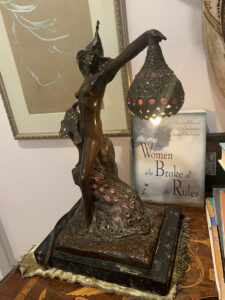
 JP sent me a fabulous Art Nouveau style figural table lamp, a nude woman supported by a peacock. The woman’s outstretched arm holds the light fixture, a globe shape, encrusted with jewel like crystals, glows when lit. JP wonders if this it “something.”
In the history of lighting design, YES, it IS something. Because in the first quarter of the 20th century, the era of Art Nouveau in Europe, early lamp makers focused on semi nude nubile young females as both the subject and the ‘holders of the light’ for this new thing called a “lamp.”
Art Nouveau Period High Point For Naturalistic
The period loved organic, NON geometrical, lines and the exoticism of the female nude, AND the association with the nude to nature. Often lamp makers included a BRONZE of the nude with a certain type of shade. For example, a Nautilus shell, or a bronze shade, encased with pinpoints of jewels, such as in JP’s lamp. Many reasons for this existed. They wanted to celebrate the beauty of the nude in a tasteful, novel way and “illuminate” her with newfangled electricity.
The original made in 1910 adorned the bar of the Adams Mark Hotel. A bronze elegantly draped figure held a lantern in miniature lit by a bulb. This served a few purposes. Bar patrons, limited to males, admired her form, and the dark bar needed light.
In the Art Nouveau period the collision between the modern world of technology and the old world of beautiful sculpture resulted in the beautiful excessive elements of design. Only the wealthy afforded a lamp, and indeed electricity in their homes or businesses. I find it amusing that the people who COULD have such lighting preferred to use the semi naked female form as the “lamp base!”
Is JP’s Lamp Original to the Period?
I don’t think it’s “period” (1900-1925) Art Nouveau, but a later copy from the 1980s when a resurgence of Art Nouveau hit the US. Her lamp is “after” the design by Maurice Wolfer (1886-1976). “After” means someone got ahold of the mold or a lamp from 1910 by Wolfers, and made a plaster cast, then had it cast in bronze to sell on 1980s market….and yes, because there was so few copyright issues from that period, it was DONE.
Some of the most notable lamps of the period were modeled on the great beauties of the age, 1900-1925, such as the actress Loie Fuller (1901) inspired the lamp maker Larch. Fuller is reenacting a famous stage roll, in a lamp, seminude, and holding a globe which is lit in this small table lamp, and such a thing can sell for $4,000.
Another highly valued lamp is a famous beauty of the age holding aloft a nautilus shell—the shade. This will sell for $4,000. Art offered a great excuse for female nudity.
Erotic Lamps
An interesting techniques of the era made the light bulb part of the erotica. In some cases the semi nude holds a light bulb encased in a shell or globe in her hand. Perhaps the most inventive techniques caused the light to ‘glow’ inside the bronze of the nude’s skirts. This showed both her form and legs, allowing the peep show to become an actual LAMP. Lamp maker Laport-Blairsy created such a lamp in 1910. A wonderfully semi clothed actress playing a Classical role, draped in Grecian flowing robes, caught in the act, spins, robes swirling metaphorically outward. This outward arch of her robes is the PERFECT shade for the 1910 light bulb! A lamp like this sells for $4,000-5,000.
JP’s lamp, because it is a 1980s recast, is STILL valuable. But at $500, a far cry from the original of made in San Francisco in the 1910s at $4,000.